Global Uprising
cover to Maintenant. Photo: Jean-Pierre Sageot
cover to Maintenant. Photo: Jean-Pierre Sageot
GLOBAL UPRISING
cover to Maintenant. Photo: Jean-Pierre Sageot
Our present is defined not only by global uprising, but, even more decisively, by the open-endedness of global uprising. To speak of uprising today is no longer to speak of an event or moment in time, but of a protracted, discontinuous temporality. Uprising in many senses is our present: part of the way things just are. If 2020 has so far felt at once strange and eerily familiar, it is in part because it bookends a full decade of open global revolt. Here we are, yet again. That year of “living dangerously” in 2010/2011, so associated with the “Arab revolts” and the “Occupy movement,” has turned out not to be a ruptural exception, but the start of a new norm; the opening of a long duration of uprising that has exposed and hastened the unravelling of the post-war global liberal order but in which no new decisive stabilization has emerged. A decade later, America’s cities, caught in the entangled knot of mass unemployment, a mismanaged pandemic, deepening dispossession, and relentless anti-Black violence, are engulfed by an anti-racist uprising so widespread and intense as to probably have no local historical precedent. And this time the stakes are that much starker, the forces of reaction that much stronger.
This is a decade that demands we rethink what constitutes uprising. What do we call this discontinuous chain of forms of refusal, protest, disobedience, and flight? How do we historicize it? What kind of concepts might capture and make sense of the ubiquity of shared feelings of having had enough, of being unable to tolerate things as they are, of the willingness to put bodies and life on the line? How have modes of action and mediation changed across this decade? It is too easy and, surely, too facile to say we live in a post-revolutionary time in which large-scale transition is no longer possible—this itself might still be contested—and that the cycle of uprising is just that, a circular repetition in which little actually changes. The onus instead is to rethink how we understand collective action and its effects today.
The uprisings are undoubtedly diverse and locally contingent: they can take sharply different ideological bents across right and left divides, or at times seem to have an indeterminate or not yet settled relation to ideological currents; they occupy different points along geopolitical faultlines and are exposed to different orders of state and imperial violence. At the same time, there is no doubt that the uprisings are connected in ways that exceed the politics of solidarity. They are connected in material historical terms across structures and circuits that shrink the space between the purported “liberal-democratic” world and its various others: police violence, its connections to militarism, and the almost complete indistinction between policing and war; rampant inequality, crises of accumulation, and deepening dispossession and extraction; global regimes of racialization and anti-Blackness; the weakness of political parties and the strength of crowds and abiding tensions between mass politics and communal exit; and the ambiguous centrality of digital mediation and visuality. These are the recombinant but global coordinates of uprising. The present of uprising is also in many senses the present of convergence.
This series takes the Middle East—a region arguably at the heart of the entanglement of policing and war—and the tenth anniversary of the Arab revolts as a springboard for a set of workshops around global uprising. We envisage these workshops as a series of open and incomplete conversations; not the presentation of finished ideas or work, but the thinking through together of a host of questions and ideas emerging from and responding to our present. To that end, each workshop will revolve around three speakers and a discussant.Instead of a traditional paper panel we invite speakers to each give ten-minute interventions that respond, from their own current work, to a set of questions and prompts. A discussant will respond in a way so as to mediate a wider conversation first between the participants and then with the larger audience
Global Uprising was developed by Jared McCormick and Nasser Abourahme.
This website is built off of the 2020–2021 series at NYU’s Hagop Kevorkian Center for Near Eastern Studies:
Digital Forays in Middle Eastern Studies & Global Uprising.
All of the events in these series are our attempt to address public programing in this moment of remote instruction and distance - but they were also built directly into the classroom.
This platform is the result of student group work through our required core course for incoming graduate students: Problems and Methods in Middle Eastern Studies.
The 22 students faced a difficult task: to enter the program & begin their degrees studying remotely. To meet this challenge, we designed the course so that students could work in smaller groups to think through the events in each series. We view this as a novel way for cohort building, a way to integrate asynchronous material into the classroom, and a unique opportunity to model public scholarship!
The 4 groups (Apple, PAH, Saffron Vesper, Octopus) were charged to work together to EXTEND the events to which they were assigned. This was realized through:
This was their prompt for the extension:
This “extension” might take many forms: a deeper dive into one of the presenters’ work, a lesson plan for a high school classroom around the event, developing a concept from the event and extending it into a new application where your group applies it differently? This is NOT a synopsis of the event, it is meant to E_X_T_E_N_D the event into new directions based on your groups’ thinking and conversations.
We asked the students to map out what the event aimed to achieve, what transpired in the conversation, and then develop a meaningful extension that synthesizes new directions! We know that working in groups is difficult - but it’s the real world. These assignment are in the spirit of thinking & working collectively.
FALLSchedule2020
SpringSchedule2021
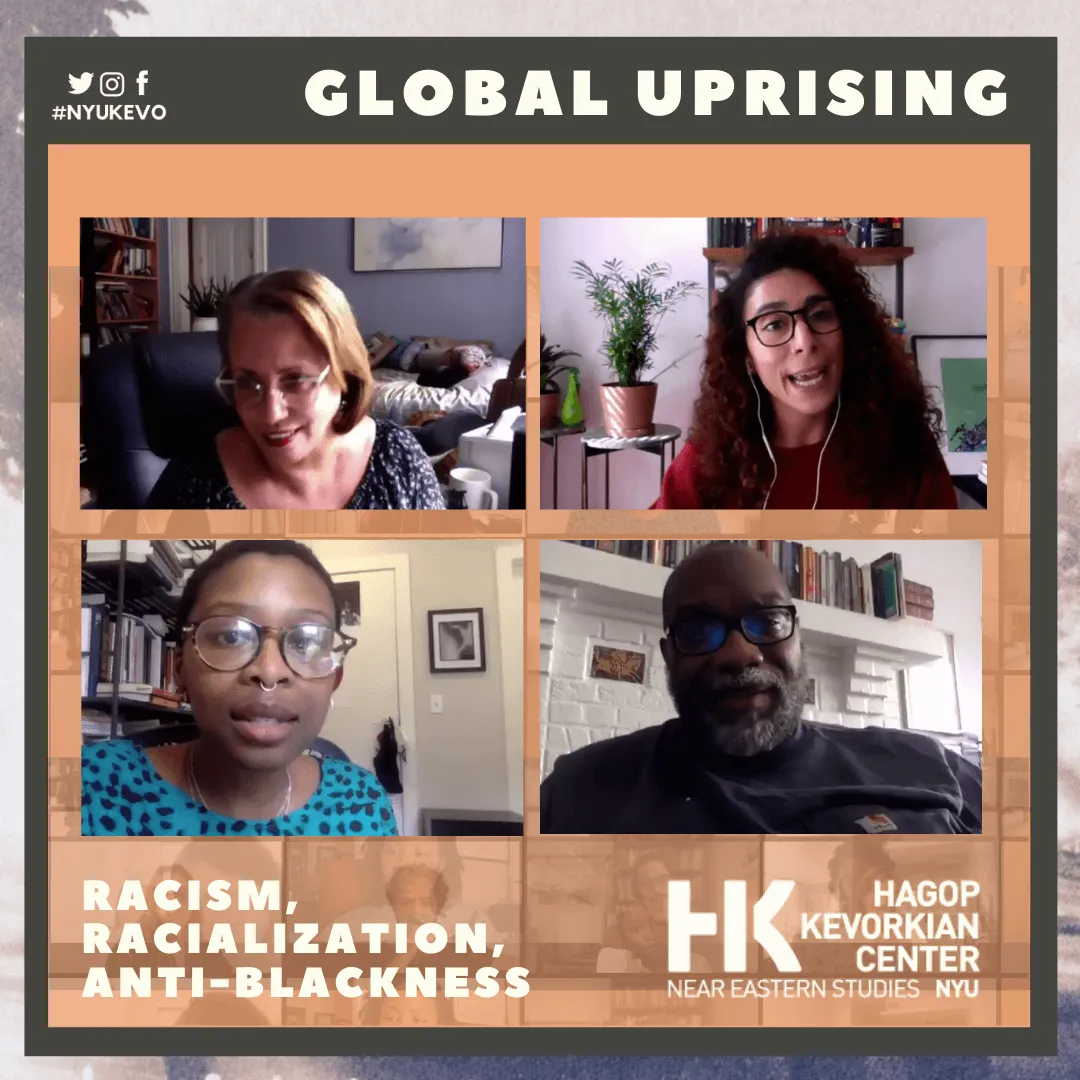
Sept 15, 2020Sophia Azeb // Eve TrouTt PowellZoé Samudzi // Fred Moten
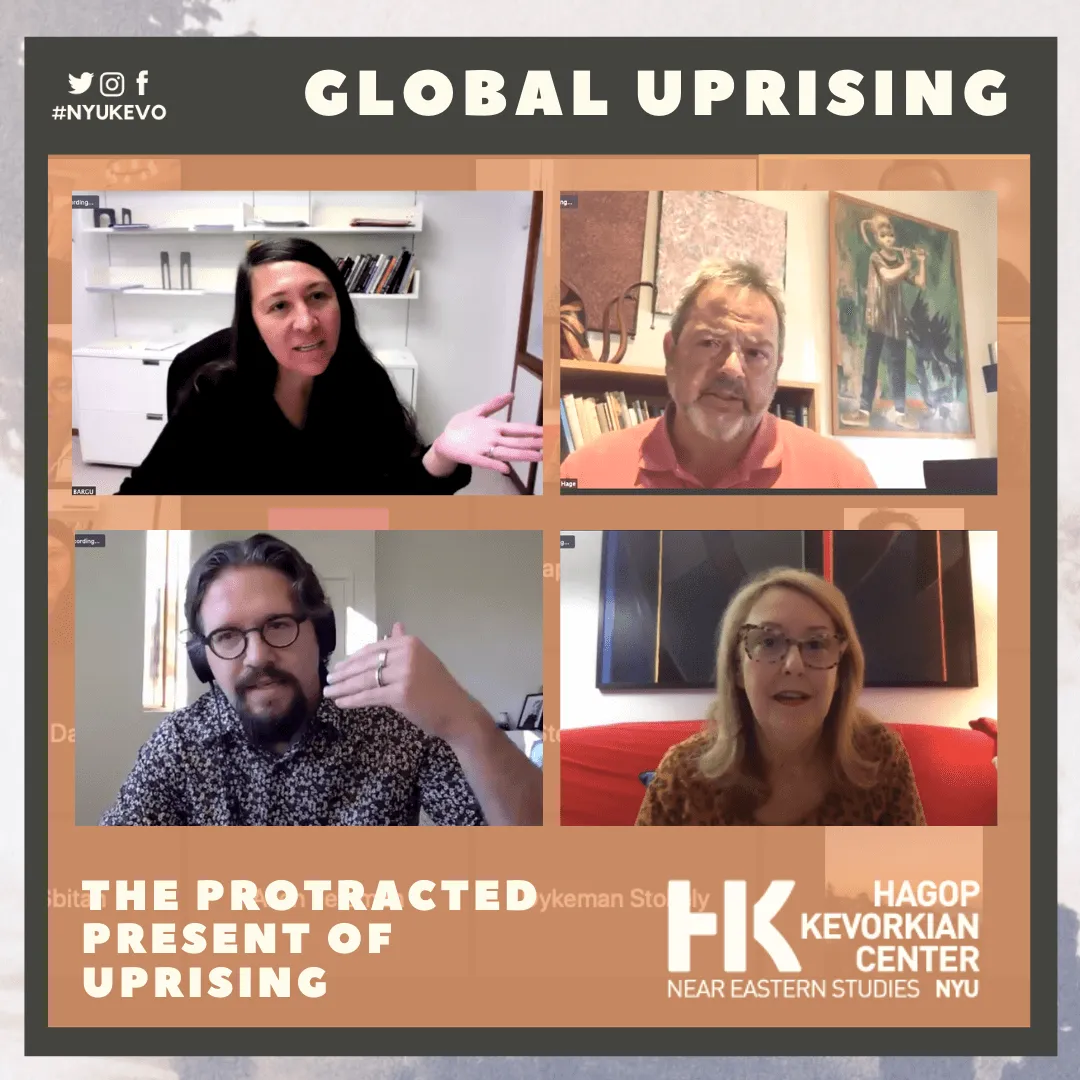
Oct 20, 2020Banu Bargu // Ghassan HageAlberto Toscano // Lisa Duggan
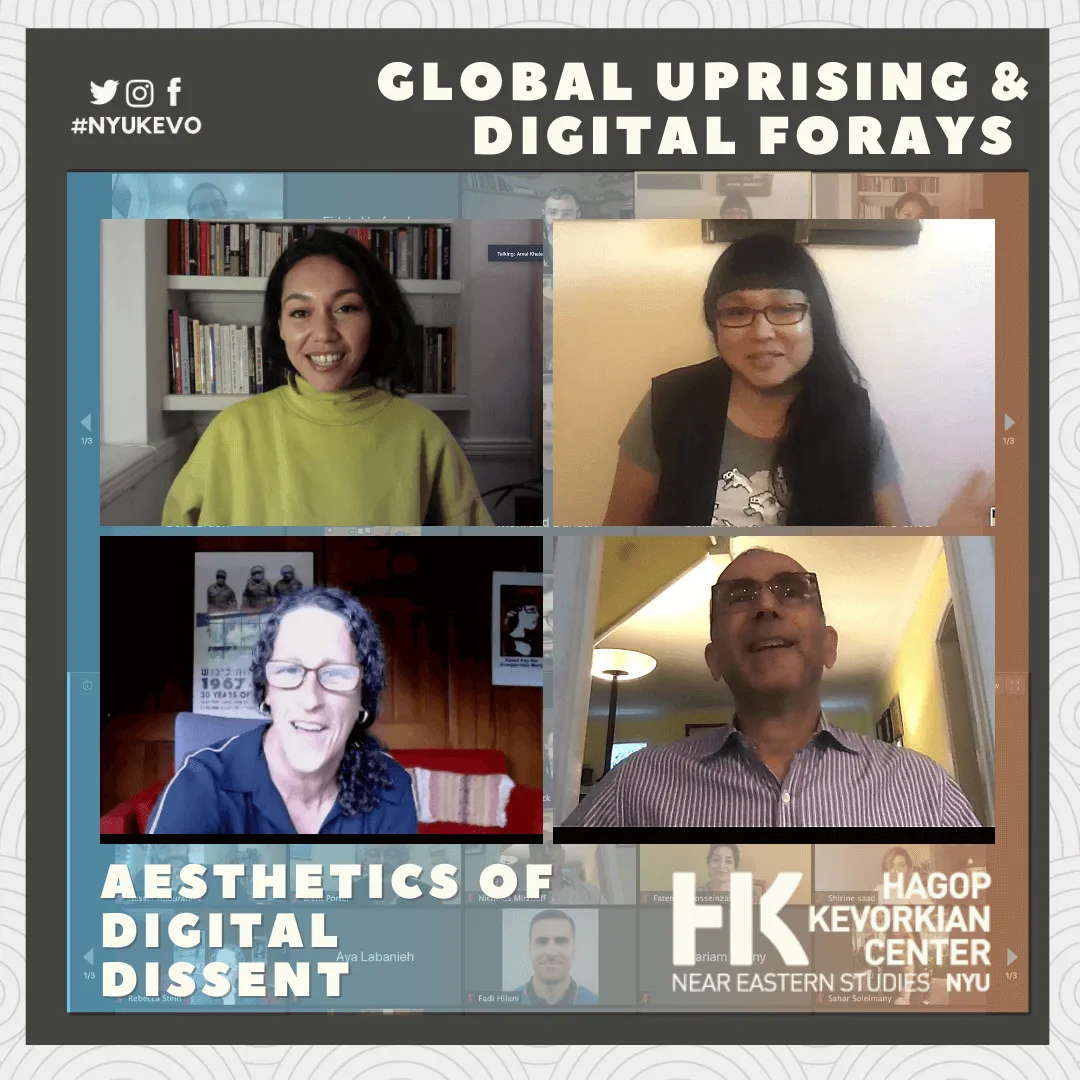
Oct 29, 2020Amal KhalaF // An Xiao MinaRebecca Stein // Nicholas Mirzoeff
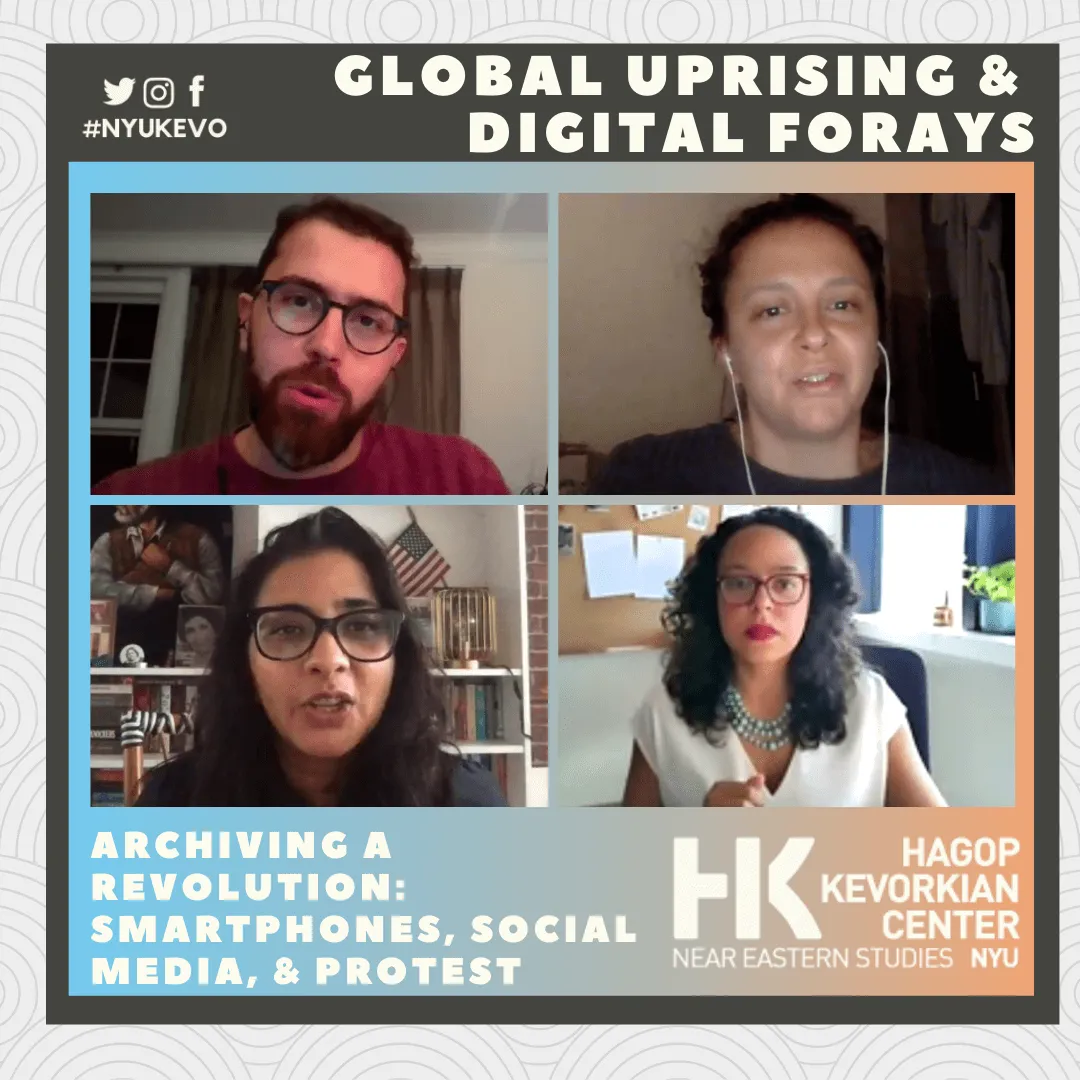
Nov 5, 2020Omar Al-Ghazzi // Jasmina MetwalyIsra Ali // Marie Grace Brown
Nov 15, 2020'llima Long // Sean ConnellyNida Sinnokrot // Nasser Abourahme
Nov 17, 2020Brenna Bhandar // Julia Elyachar Sherene Seikaly
Nov 24, 2020Narges Bajoghli // Manata HashemiM. Ali Kadivar // Peyman Jafari
Dec 8, 2020Pinar Bedirhanoğlu // Nils GilmanAdam Hanieh // Aaron Jakes
SpringSchedule2021
Jan 26, 2021Nadia Abu El-Haj // Paul AmarStuart Schrader // Nikhil Pal Singh
Feb 9, 2021Anthony Alessandrini // Ayça Çubukçu Bargu // Alejandro Velasco // Vijay Prashad
Feb 24, 2021Nadje Al-Ali // Frances Hasso // Jasbir Puar // Gayatri Gopinath
March 9, 2021Joshua Clover // Dean Saranillio // Nazan Üstündağ // Lenora Hanson
March 23, 2021Madiha Tahir // Randa Wehbe //Amina Zarrugh // Sinan Antoon
April 6, 2021AslI Iğsiz // Leopold Lambert //A. Naomi Paik // Paula Chakravartty
What are the political concepts we need to make sense of the last ten years of uprising? Can or should we think of these uprisings in temporal terms? Can we go further and historicize them—what would this be the age of exactly? And how has uprising, understood as a kind of praxis, changed over the decade? In turn, how might we think through what is left of the concept of revolution, and its various dilemmas (vs revolt, vs reform etc.)? Are other adjacent concepts—insurrection, riot, rebellion etc.—now more useful? And finally, what does parsing the temporality of the uprisings across a “global” scale do to still standing political distinctions between the “liberal-democratic” and “post-colonial” worlds?
Banu Bargu is associate professor of History of Consciousness at the University of California, Santa Cruz and currently a member at the Institute for Advanced Study. She is a political theorist, with a focus on modern and contemporary political thought and critical theory. Her first book, Starve and Immolate: The Politics of Human Weapons (Columbia UP, 2014), explored self-destructive protests in the context of Turkish prisons through the ethnography of a radical movement. This book received the First Book Prize given by the Foundations of Political Theory section of the American Political Science Association and was named an Outstanding Academic Title by Choice. Bargu is also the editor of Turkey's Necropolitical Laboratory: Democracy, Violence, and Resistance (Edinburgh UP, 2019), co-editor of a special issue of the journal Rethinking Marxism on Louis Althusser (2019), and co-editor of Feminism, Capitalism, and Critique (Palgrave, 2017).
Ghassan Hage is a Professor of Anthropology at the University of Melbourne. He has worked for many years on racism and white nationalism from a comparative perspective. His recent work Is Racism an Environmental Threat? (2017) deals with the common basis for the colonial practices of racialization and exploitation of people and the speciesist practices of exploitation of nature. His main ethnographic work has been on Lebanese diasporic culture. A monograph on the topic will be published by the University of Chicago Press in 2021. He has a long interest in critical anthropological theory and has written Alter-Politics: Critical Anthropological Thought and the Radical Imaginary (2015). He is currently writing a book on Pierre Bourdieu also for Duke University.
Alberto Toscano is Reader in Critical Theory and Co-Director of the Centre for Philosophy and Critical Thought at Goldsmiths, University of London. He is the author of Fanaticism: On the Uses of an Idea and Cartographies of the Absolute (with Jeff Kinkle). He edits The Italian List for Seagull Books and sits on the editorial board of the journal Historical Materialism.
Lisa Duggan is a journalist, activist, and Professor of Social & Cultural Analysis at New York University. She is author of Sapphic Slashers: Sex, Sensationalism and American Modernity and Twilight of Equality? Neoliberalism, Cultural Politics and the Attack on Democracy, co-author with Nan Hunter of Sex Wars: Sexual Dissent and Political Culture, and co-editor with Lauren Berlant of Our Monica, Ourselves: The Clinton Affair and National Interest. Mean Girl: Ayn Rand and Neoliberal Greed is in the new e-book series she is co-editing with University of California Press, American Studies Now. She was president of the American Studies Association during 2014-2015.
Part of the Fall 2020 course Problems and Methods in Middle Eastern Studies


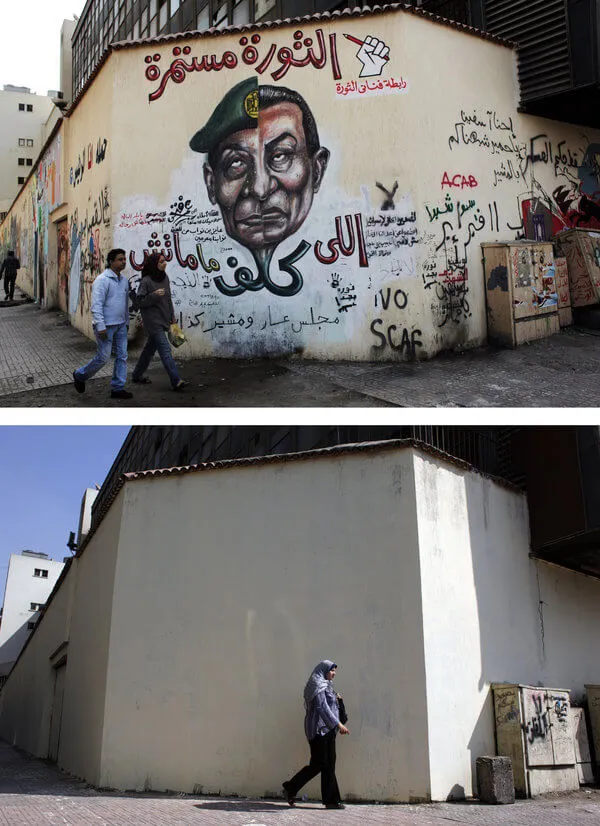
A mural in Tahrir Square, Cairo, was whitewashed in October 2012 and later repainted by graffiti artists. (Reuters)
When synthesizing the event, we found ourselves grappling with new terminology. Many of the terms embraced by academics to talk about revolution appear distant from the phenomena they seek to describe. This is inevitably because they are enmeshed in decades of debates and different schools of thought. Still, the concepts which become part and parcel of intellectual discourse are in many ways rooted in social movements, so the question becomes: why do these concepts often look so different when they travel from the square to the ivory tower?
We struggled with the conceptualization of the body and the social. What follows is an attempt to grapple with the concepts which the speakers have provided to help us think through the past decade of uprising and revolutions. This exercise was fruitful for us in understanding the event itself, but it also left us wondering, can the gap between academic discussions about uprising and the uprisings themselves be breached? What is at stake when we conceptualize uprisings and revolutions?
In what follows, we too engage in academic writing style that might be inaccessible to many. We realize that there is a tension here that is a common problem in the role of the intellectuals and their areas of interest. In this event, we were challenged as a group to engage with the terminology that was presented by the speakers, and on a personal level we were challenged to respond to these big questions in simpler accessible language when talking to our family members and friends.
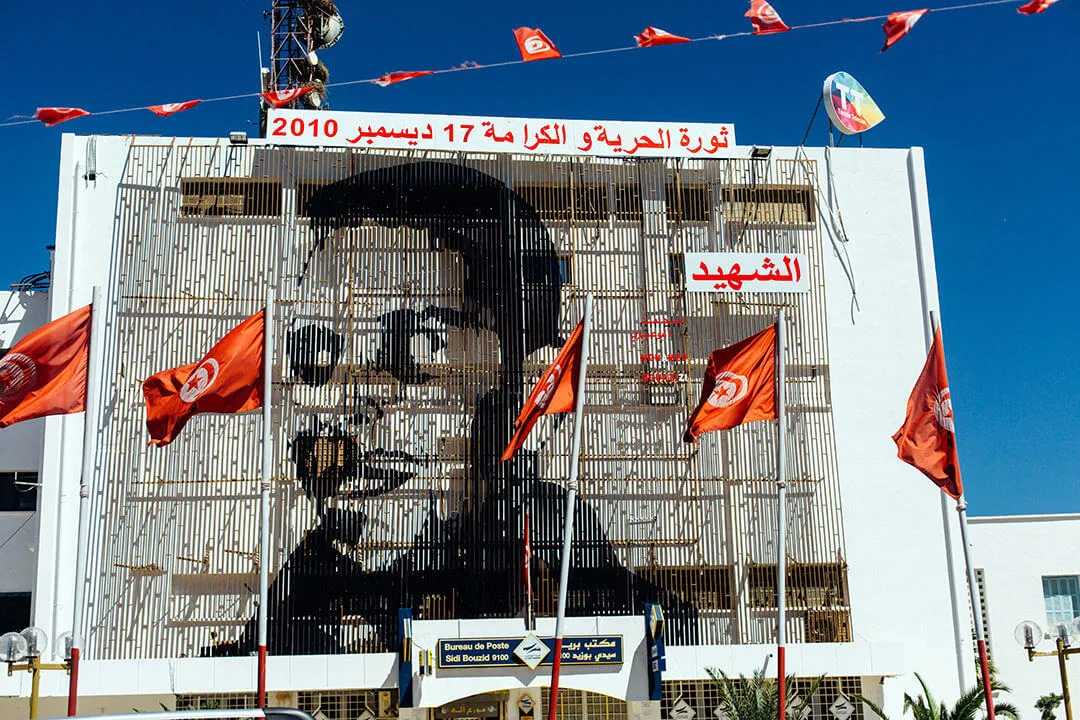
A monument to Mohamed Bouazizi in Sidi Bouzid, Tunisia (ECCEB/Atlas Obscura)
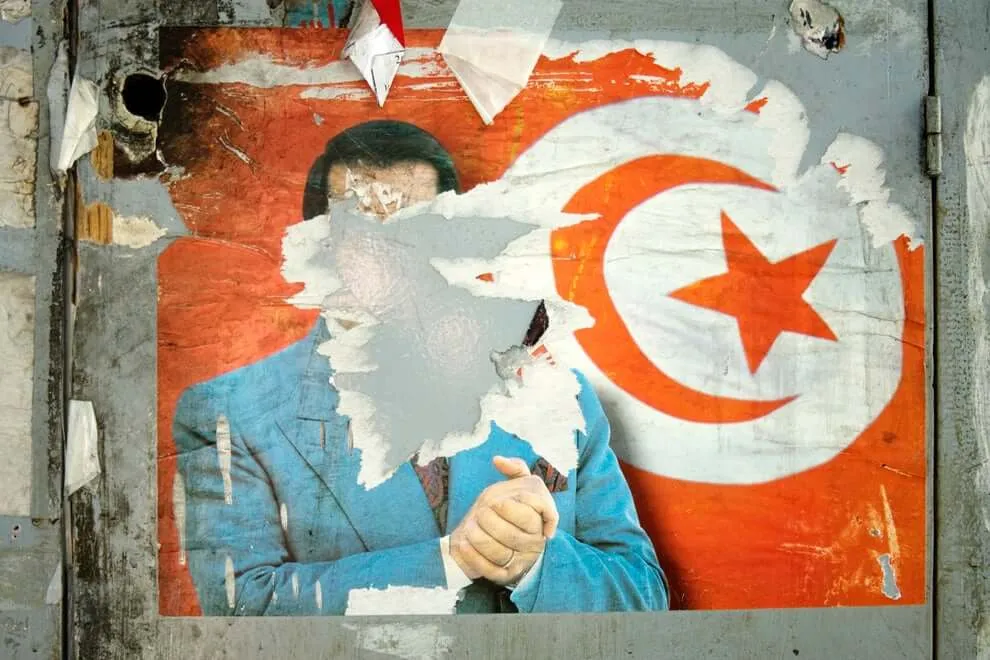
A torn poster of overthrown Tunisian President Zine El Abidine Ben Ali. (Getty)
In response to Nasser Abourahme’s question about necessary concepts, Banu Bargu gave us the concept of ‘the body’ to help us make sense of the last decade of uprising. She is thinking with examples of bodily harm as resistance to oppression. We provide here three examples of protesters who use their bodies as a means of insurrection: Mohamed Bouazizi, Maher al-Akhras, and Loujain al-Hathloul.
On December 17, 2010, Mohamed Bouazizi set himself on fire in front of the provincial government building in the town of Sidi Bouzid, Tunisia in an act of self-immolation and political protest. As a street vendor, Bouazizi had been targeted by the local police repeatedly for several years. Bouazizi was once again harassed by the police on the morning of December 17 for lacking a vendor’s permit and refusing to pay a bribe. A municipal official followed up by confiscating Bouazizi’s electronic scale and knocking over his cart. Bouazizi went to the government building to make a complaint, but was denied entrance. Two and a half weeks after his self-immolation, Bouazizi succumbed to his injuries and passed away on January 4, 2011. Bouazizi’s political protest, against both the economic inequalities in Tunisia and the repressive security apparatus that enforced these conditions, led to an uprising across Tunisia and others in the rest of North Africa and the Middle East that resulted in political change in Tunisia, Egypt, and Yemen, the last of which has resulted in a protracted civil conflict as with Libya and Syria.
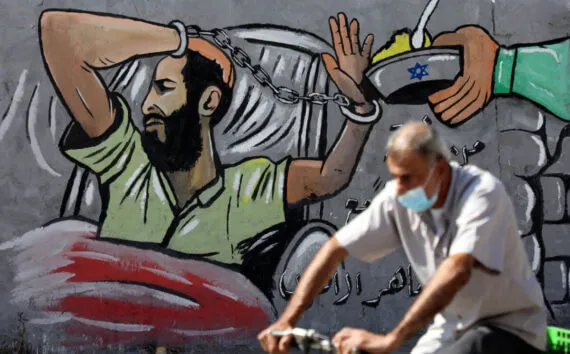
A man bicycles past a mural of Maher al-Akhras in Gaza City in October 2020 (Getty)
On July 27, 2020, Maher al-Akhras was arrested by the Israeli Shin Bet forces and was put in administrative detention. ‘Administrative detention’ is the Israeli method for incarcerating Palestinians without pressing charges or holding trial, which makes it impossible for detainees to defend themselves against administrative detention order. In protest, on the day of his arrest al-Akhras began a hunger strike. After more than a hundred days, during which al-Akhras was in critical condition, the Israeli authorities had agreed to not extend his administrative detention beyond November 26 (the original date for the expiration of the detention order), if al-Akhras ended his hunger strike. Al-Akhras agreed to the condition and is expected to be released on November 26.
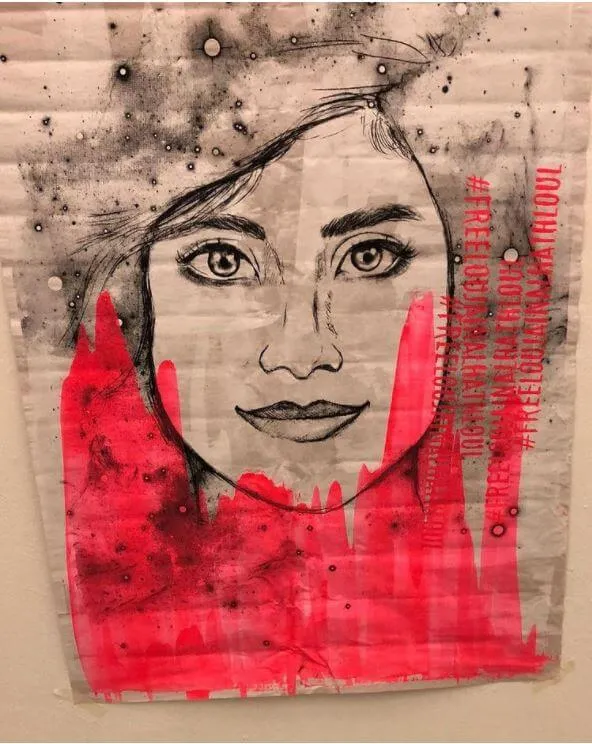
A paste up of a collaboraton between Melbourne-based Saudi artist Ms, Saffa and American artist Allie Ballesteros calls for Loujain Hathloul’s release. (Ms. Saffa/Instagram)
Loujain al-Hathloul is a women’s rights activist in Saudi Arabia. Al-Hathloul has been in and out of jail on several occasions due to her active political expression and calls for structural change by defying many of the oppressive patriarchal laws, such as the right to drive and the male guardianship system. Al-Hathloul has now been detained by Saudi Arabia since May 2018. Several human rights organizations have reported that al-Hathloul has been tortured extensively throughout her imprisonment, and her trial has been indefinitely postponed. In August 2020, al-Hathloul successfully went on a six day hunger strike in order to get permission to speak to her family, an opportunity previously denied to her but permitted to others. On October 26, 2020 al-Hathloul began a new hunger strike to demand regular phone calls with her family. Under international pressure stemming from this most recent hunger strike, the Saudi authorities at the time of this lecture were reportedly considering al-Hathloul’s release ahead of the upcoming November 2020 G20 summit.
Returning to Bargu’s intervention, we asked ourselves, what does ‘the body’ mean? What can a focus on ‘the body’ do? What does a focus on ‘the body’ render visible? Poignantly, Bargu argues that acts of self-harm as resistance, such as Bouazizi’s self immolation, and al-Akhras’ and al-Hathloul’s hunger strikes, turn the body into both an object and subject of violence. An object, because structural violence operates on the body. A subject, because a political act of self-harm reflects the violence of the regime back at it. It is a “somatization of structural violence,” Bargu further argues, which presents a critique of a disembodied conception of politics. Indeed, a focus on ‘the body’ renders visible the corporeal dimension of resistance. As Bargu notes, these acts are “writing the body back into the social.” In paying close attention to the weaponization of the body as a form of protest, we are able to notice the nuances of this form of resistance. With that in mind, we turn to ask: what does a focus on ‘the body’ as a concept render invisible?
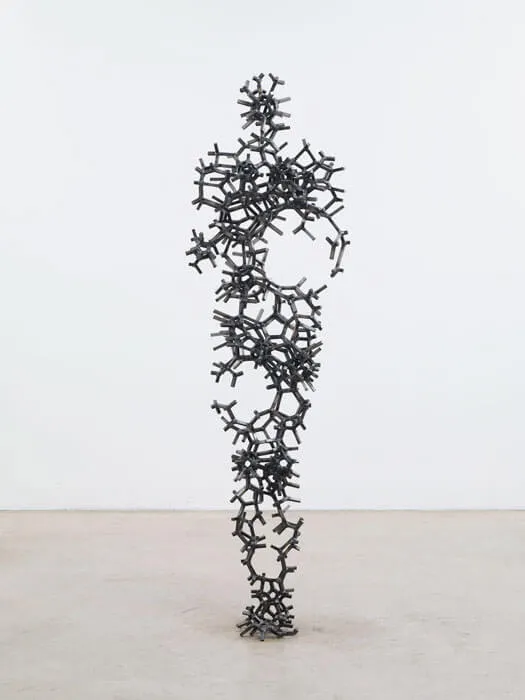
APERTURE XVII (2011) by artist Antony Gormley .
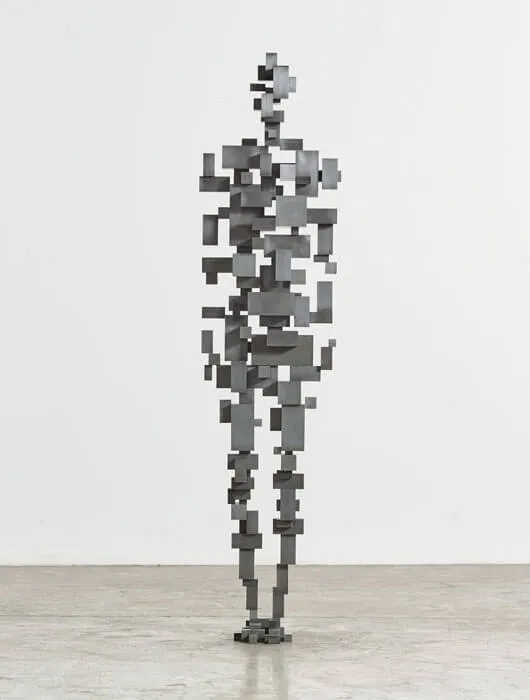
SUBLIMATE XIII (2007) by artist Antony Gormley .
‘The body’ as a concept could help us understand the uprising and provide a technical tool to explore the ‘how’, but the ‘why’ could slip away when X will use their body in a relation to the political and socio-economic rationale behind the act. The death of Alan al-Kurdi, for example, sparked heartwarming acts throughout Europe to welcome refugees in the short term, but in the long term it failed; individualizing al-Kurdi’s body failed to address the reasoning of why the family was forced to seek refuge in the first place. The problem of this approach deals with consequences rather than the causes. As these acts happen on the margins, they do not reach the surface unless they end with death. We fear the focus on the body as a weapon against the state, as much as it is important to understand, may shift the focus away from the circumstances that create a deprived situation that leads X to harm themselves. The poetics and romanticized ideas, probably, are the last thoughts behind X intention. Indeed, while the hunger strike is the weapon, the act’s context should remain in our focus when attempting to understand the greater reason behind it.
Can ‘the social’ as a concept help us better understand uprisings and revolutions in the 21st century?
In his talk, Hage described the L-shaped spatial distribution of the uprising in Beirut. “In the top of the L, were people who were facing the parliament and were looking for confrontation and wanted to engage the police… A bit further down the L, there were people who were engaging in creative sloganeering and graffiti… On the corner of the L you had academics doing sit-ins and engaging in teach-ins. And on the bottom of the L, facing the mosque, there was a huge section of the population, which was political because it came down [to the protest], but there was more carnival feeling with families with kids, ice-cream, popcorn and what have you” (24:00). Hage describes the L shaped clusters of protesters in order to ask, what do these protesters have in common, besides a general dissatisfaction with the political situation in Lebanon? For Hage, it is a “desire for the social” that brought the protesters down to the streets. When we were thinking about how to synthesize this event, we were wondering what does ‘the social’ even mean? What is its antithesis? Why is there a ‘desire’ for ‘the social’? And, can ‘the social’ as a concept help us better understand uprisings and revolutions in the 21st century?
This past decade of uprising, the protracted present, is defined by the neoliberal era which began its ascendancy in the 1970s and fully asserted dominance in the early 1980s. The neoliberal era of global capitalism, which continues through the present, was a direct response to the democratizing trends of the 1960s and has dramatically escalated economic inequality and placed political power solidly back in the hands of the global elite. Neoliberalism, or neoliberal capitalism, considered narrowly characterizes economic policy centered around the primacy of the free market such as the dismantling and privatization of state-functions or the welfare state, and the deregulation of markets. More broadly, neoliberalism can also be considered as a cultural, sociopolitical ideology that emphasizes individuality, diminishing the power of labor unions and collective action.
Largely influenced by the withdrawal of the state from social institutions and burgeoning rates of both deindustrialization and financialization, we have seen traditional modes of struggle change. In Joshua Clover’s Riot. Strike. Riot: The New Era of Uprisings , he asks provocatively: In the absence of robust organized labor in much of the world and the inability to directly affect global market-based prices with local looting and riots, what type of revolt is possible? Or, put by Toscano, how does one “extract, develop, reinvent a theory of revolution in the absence of its traditional Marxist referents?” Neoliberalism has had a marked effect on the acceptable boundaries of political economic thought. The dominance of the market has a tendency to act as an ideological prison, preventing most professional or public intellectuals from venturing outside what is considered normal and natural. Neoliberalism’s market fundamentalism actively cultivates compliance and manufactures consent.
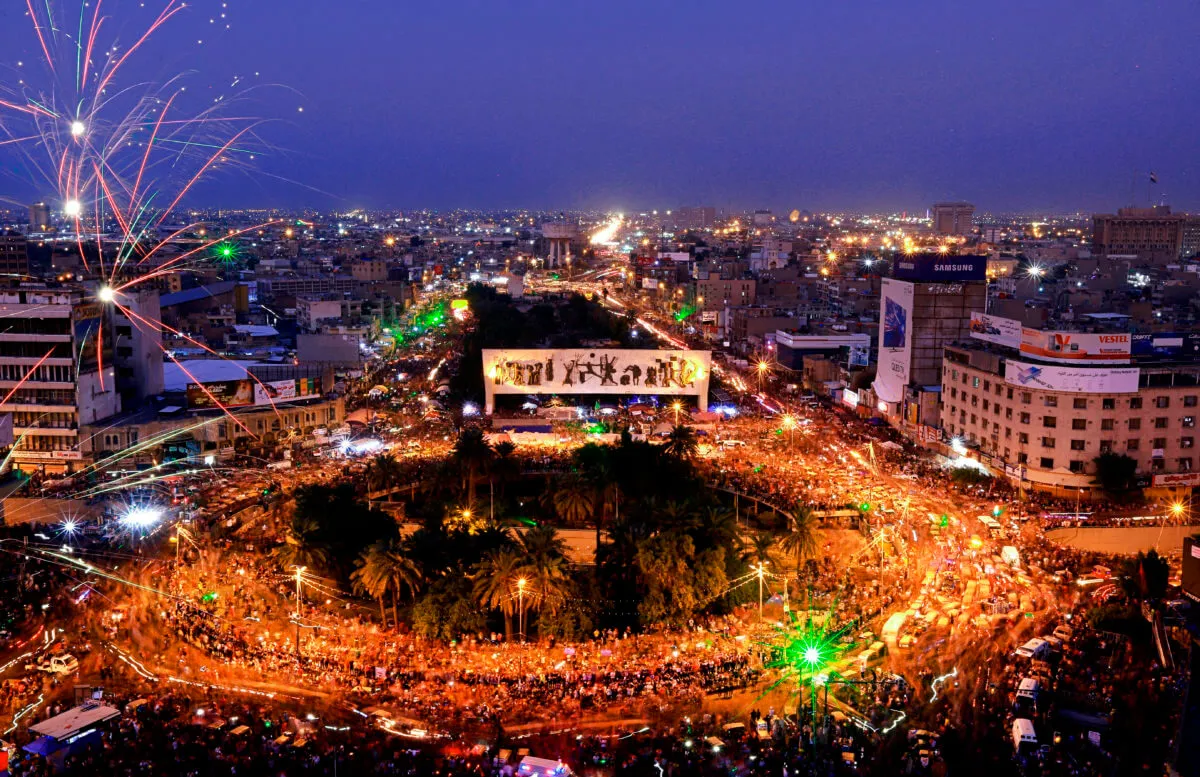
A protest camp in Baghdad’s Tahrir Square in October 2019. (Khalid Mohammed/AP)
The strict limits held by neoliberal thought have been on display during the contemporary moment of protest and revolt in the early 21st century. While the causes of uprising around the world ought be attributed to neoliberal policy, resulting in severe inequality, segregation, and deprivation, the popular dissent that has characterized the years since the 2008 global recession has been deradicalized, largely ignoring any proposals for reconfigured property relations or a fundamental redistribution of wealth and resources. This is not to say that no one or no organization who has participated in the protracted present of uprising has manage to think outside the limits of neoliberalism; the 2011 Egyptian uprising was split, “between systemic and antisystemic opposition groups,” but the victors in the intra-movement power struggles at large have been non-revolutionary elites who co-opt the movements conform to neoliberal strictures. A distinguishing trait of neoliberal capitalism as it spreads through the coercive forces of globalizing financial institutions is the proliferation of non-governmental organizations and the professionalization of political activism.
In the neoliberal era, professional advocacy groups and political elites nearly unanimously speak in the language of the post-World War II western framework of human rights. NGOs engage in work related to women’s rights, youth activism, development, and self-help, backed by international and corporate donors. This neoliberal human rights discourse certainly devotes attention to important issues, but inherently ignores any discussion of economic rights as human rights. Poverty reduction comes in the form of charity or microloans, while refusing to support economic rights such as the right to publicly-funded healthcare, the right for labor to collectively organize, or democratic control over corporate wealth and private industry. The discontent that fueled the 2011 Arab uprisings and the various movements around the world in this past decade can be attributed to neoliberal capitalism, but these uprisings have ultimately failed to articulate that reasoning in a united platform; a, “painful paradox… [of] revolutionary mobilization with a reformist trajectory.” Nearly ten years on from these rebellions, the outcomes in the regional Middle East and North Africa range from new articulations of old political structures to protracted, violent, civil conflict.
And yet, how has neoliberalism affected the way we relate to one another? It is perhaps the ubiquitous pervasiveness of neoliberalism into the most intimate forms of human relationality that has brought about a form of uprising that is not a social movement, but a social space. Almost as if it is in the state of exception, that is the uprising, that ‘the social’ can be realized. If we are inclined to borrow Agamben’s notion of the “state of exception,” and the eventual evolution of the ‘exception’ into the ‘rule,’ then perhaps, if we follow Hage in seeing the uprising as a social space that is realized only when there is an exceptional time of protest, this social space can be normalized and become the rule? In other words, perhaps it is the very unstructuredness and heterogeneity of the revolutions of the 2000s that allow them to speak back to neoliberalism and its pervasive individuating effects.
a form of uprising that is not a social movement, but a social space
If the “desire for the social” is in part a response to the atomizing effects of neoliberalism, how do recent uprisings attempt to undo these neoliberal subjectivities through use of public space? How do uprisings re-imagine social relations and subjectivities? Congregating is itself an act of coming together and a visible rejection of individuation. But the public spaces—parks, streets, sidewalks, buildings, walls, squares, traffic circles—used by the people in protest movements in Cairo, Beirut, Bahrain, Tunis, and so on, have arguably served as more than just the settings of uprisings.
Lefebvre and other scholars in recent decades have criticized the privatization of urban spaces. The “capital-based interests” of authorities, they denounce, result in the “loss of [the people’s] ownership” of public space. This lack of public space creates social fissures and severely limits participation in social and civic activities. In Cairo for instance, the state even before Mubarak neglected to invest in the neighborhoods and public spaces within the city, while the wealthy upper class relocated to private, gated communities. A lack of investment in sufficient housing, in the maintenance of streets and buildings, and a lack of public services such as waste management and clean water, compounded by surveillance and state-of-emergency laws, have prohibited access to and use of public spaces.
Beirut, as Ghassan Hage alludes to, has lost public spaces not to lack of investment, but to privatization. After the civil war, real estate developers and the joint-stock company Solidere bought up the city center and many of the city’s historic buildings that had been severely damaged during the war. These developers’ projects centered on the construction of new highways, modern architecture, private beach resorts, and high-end shopping streets. This commercialization of the city’s space and places of leisure in post-war Beirut’s downtown and coastal areas catered to Lebanese and international elites, rather than to the public.
The language of protesters in these and other cities evoke the sense “loss” that Harb articulates, as they aim to “reclaim” these spaces from the state, financiers, or private developers. In Taksim Square in Istanbul, Başak Ertür considers this rhetoric “something akin to a fantasy of ‘taking back Taksim’… as a driving force.” This notion of “taking back” the space “operates as if the square had once properly belonged to the people.” Ertür argues though that “it is that very as if that testifies to the entanglement of monumental spaces with political imaginaries that yields particular forms of spatial practices.” What then are the “spatial practices” that take place during uprisings? If the spaces themselves are tied to political and financial articulations of power, can the “taking back” of these spaces be read as an attempt to re-articulate and restructure the rules and norms of a state or society?
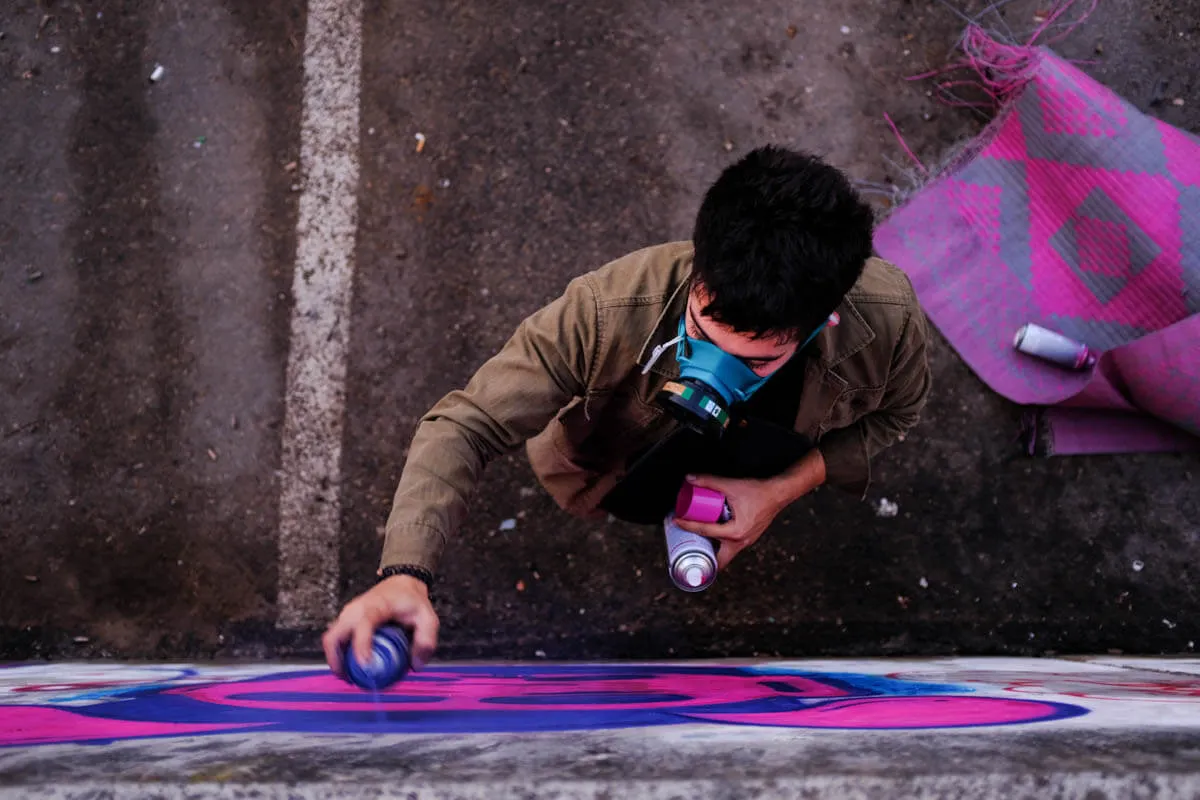
A graffiti artist paints a caricature of Prime Minister Saad Hariri during the 2019 uprising. ( Alexander Lerche / Al Jazeera )
Whether gathering in Taksim Square, in Tahrir Square, in the streets of Beirut, or writing and painting on the walls of these and many other cities, the protesters made themselves visible, saying and showing that “we are here.” As these gatherings persisted over the course of days and weeks, these protesters also began to practice new ways of living, interacting and being. People of different sects, economic backgrounds, organizations and ideologies, who normally would not have crossed paths, encountered each other and interacted daily in these spaces in new ways. Cooking, offering medical care, creating art and music, engaging in discussions, cleaning, prayer and other daily rituals took place communally. “This new art of living together, of experimenting with different forms of politics, sociality and being, exemplifies what Greene termed ‘accents of protest’ in relation to viewing places themselves as ‘rhetorical tactics in movement towards social change.’”
This communal living perhaps created “social spaces” where people were able to enact alternative social relations and imagine new political horizons during the days of uprising. The realization of new “social spaces” often did not materially endure, though. These sites, whether in Bahrain, Cairo, Tunis, Athens, or Washington, DC, become targets of the state: by barricading, transforming or destroying the physical sites themselves, the state counters these movements and attempts to reassert its power.
Regardless of the fate of the sites themselves, what happens when the protesters leave these spaces? Is this “art of living together” confined to the square and to the particular moment of uprising? Whether or not these new “social spaces” endure, can the realization of these new imaginaries persist even after the protesters are forced to return to their daily lives, which are still often structured by the same neoliberal frameworks they sought to dismantle?
One of the principal tasks faced by scholars analyzing the global uprisings of the present is to develop a way of discussing the commonalities between them without flattening their particularistic demands or positions. While the local contexts of many of the uprisings discussed in the event vary drastically, there seemed in many cases to be common languages, demands, aesthetics, historical perspectives (or rejections of historical determinism), and in some cases even a shared notion of the “global” spaces they inhabit. Such broad questions are difficult to approach without falling prey to a reductive essentialism. And yet, to focus on the different uprisings merely from a comparative standpoint misses the mark by failing to recognize the ways that uprisings and those who participate in them are always already in conversation with other uprisings, present or past.
always already in conversation with other uprisings, present or past.
Of the approaches to these questions, one which was picked up and expanded upon by the panelists and discussant was the idea of inheritance. First mentioned in the talk by Ghassan Hage, inheritance may serve as one entry point into discussions about commonality, geographic scale, and historicity in the time of revolt. But even as it keys us into continuities and commonalities in some places, in others it highlights ruptures and disjunctures. Hage, throughout his work, has a tendency to take tried and tested anthropological concepts and reinvigorate them with a new sort of propulsive power by throwing them into vastly different contexts. His invoking of “inheritance” in the event is one example of this. Inheritance is often assumed to be synonymous with lineage or genealogy, and in this sense can sometimes resemble deterministic teleologies. Writing on the historical straitjacketing of the 2011 uprisings in the Middle East and North Africa, Behrooz Ghamari-Tabrizi details how media commentators for years had tried to craft a discourse around the “Spring” of the Arab world, evocative of the “‘Spring Time of Nations’ in Europe of 1848, Prague Spring of 1968, or Eastern Europe of 1989.” “By naming it the ‘Arab Spring,’” Ghamari-Tabrizi argues, “the uprisings entered a conceptual and discursive universe with a written past and a known future direction.” Such narratives not only pigeonhole these movements, but can also force particular assumptions about who the subjects of these revolutionary movements are to begin with. Despite the social composition of protesters in Lebanon crosscutting class, nationality, or faith, many analyses expunged particular groups from these broad-based coalitions. In a recent Tweet, Mezna Qato noted, “So jarring, but maybe unsurprising, how much unanimity there is in Lebanese popular uprisings as beginning on 17 Oct 2019. As if the uprisings in the [Palestinian] camps that summer, in July, were in another country, another world. As @Hana_Sleiman points out, the non-citizen erased, again.”
However, as Hage noted, inheritance is never quite as stable or all-encompassing as it is often assumed to be. Rather, it is something that can be accepted, rejected, or “negotiated.” What would it mean, then, for uprisings to link themselves to historical conjunctures, geographic locales, or aesthetics and signs other than those accorded to them by commentators–or by History itself? To continue with Ghamari-Tabrizi for a moment, this seems to be exactly what drew Foucault’s interest to the men and women agitating for change during the 1979 Iranian Revolution:
Foucault highlighted in Iran the struggle of a nation asserting itself for both an inclusion (in making history) and an exit (from terminal history). He conceived the indeterminacy of the revolutionary movement in Iran as a possible source of creativity and inspiration rather than an expression of backwardness finally unleashed forward toward progress.
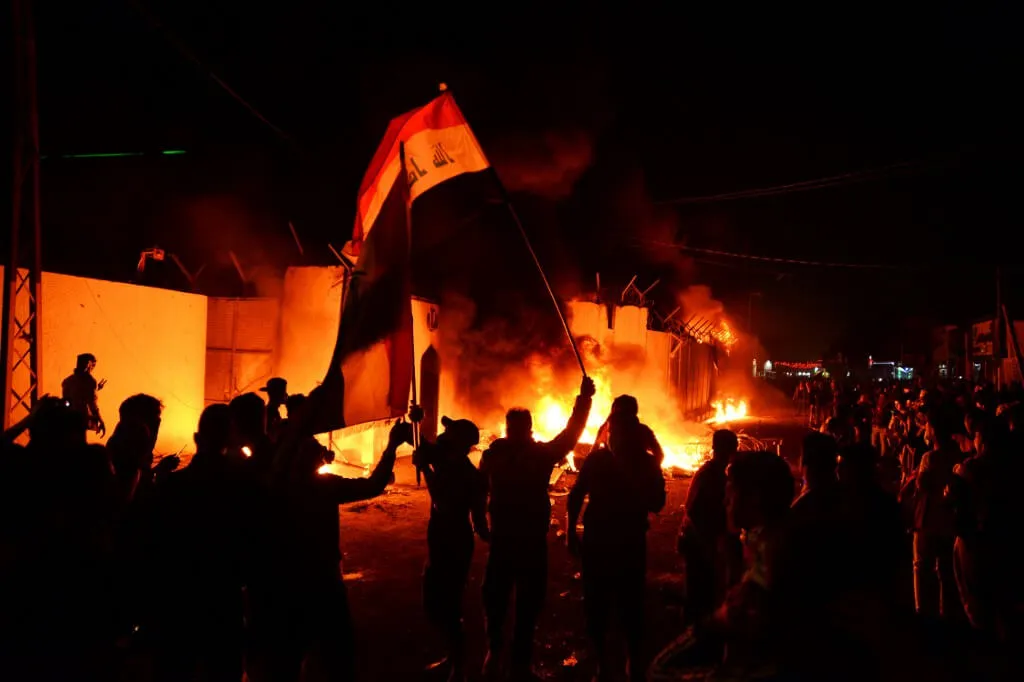
Anti-government protesters gather as the Iranian consulate in Najaf, Iraq burns in October 2019. (AFP)
In short, it is the idea of indeterminately negotiating a historical inheritance which Foucault found most striking. The challenges that these types of movements posed to the contemporary exigency of classification, of establishing historicity, can be seen too in Alberto Toscano’s comments on the idea of the riot. In refusing to articulate a particular set of demands, riots instead serve as impromptu phenomena responding with immediacy to a need for action. Defying the expression of a common platform or an inauguration into History, they can be seen as inherently “anti-strategic” but can be said to pose challenges to teleologies as well, by temporarily suspending history. But do riots not have a history of their own? Are they not in conversation with other spontaneous agitation both past and present?
The spontaneity of “riots” and their associated exceptionalism as episodes rather than sustained, organized movements complicate how they’re inscribed into history and how their inheritance might be negotiated. As Toscano suggests, “riots” have contested, racialized legacies, as evidenced in American history. Riots and rebellions of colonial settlers against the British monarchy are interpreted within a history of American might, bravery and patriotism. The violent riots in response to the Stamp Act in the American colonies in 1765, for instance, are remembered as actions that lead to American liberty from the British. Black Americans striving for liberties, though–whether during the American Revolution, the 1967 Detroit riots, or the Black Lives Matter (BLM) protests since 2014–are smeared as “looters” or “thugs.” In an article about the BLM protests from summer 2020 in The Atlantic, historian Kellie Carter Jackson contends that “Freedom through violence is a privilege possessed only by whites. Seminal moments in U.S. history that historians have defined as patriotic were also moments that denied patriotism to black people.” Writing about George Floyd, Breonna Taylor, and Ahmaud Arbery, and the BLM protests within the framework of rebellions during the American Revolution for American freedom challenges how legacies of riots and revolution are framed, and how these frameworks can be negotiated depending on one’s positionality.
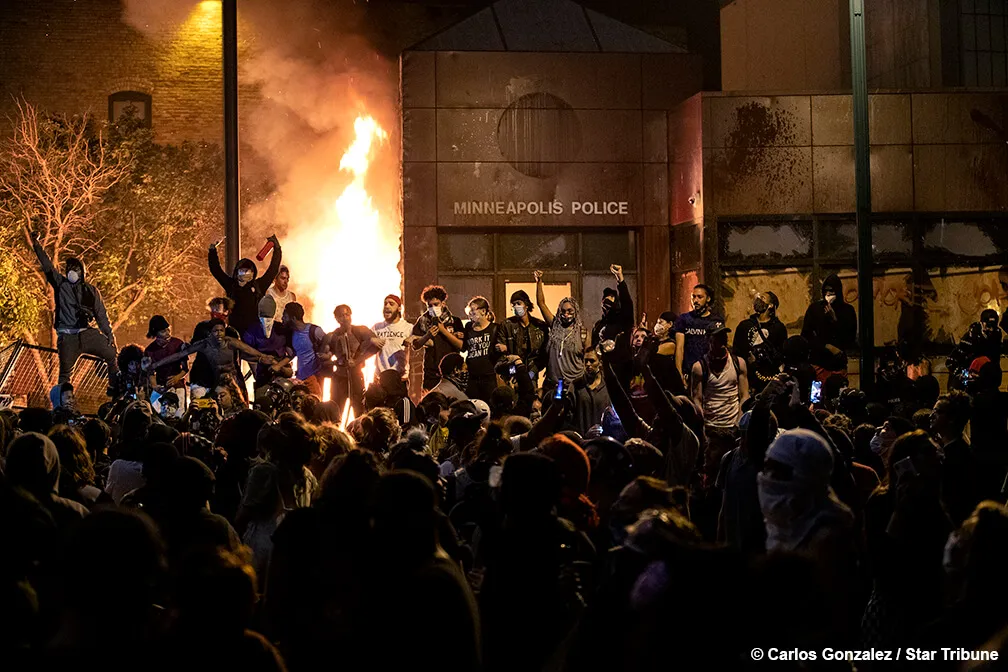
Demonstrators gather outside the burning Minneapolis 3rd Precinct on May 28, 2020 during protests against the police killing of George Floyd. ( Carlos Gonzalez/Star Tribune )
Regardless of a movement’s spontaneity, duration or ideological platform, riots, uprisings, movements, etc. all have multiple historical “reference points” as Lisa Duggan asserts. Depending on the historical lens we choose as the filter of our scrutiny, an uprising’s temporality and legacy can shape-shift. Even though the BLM movement is an organization with a coordinated, nation-wide network, the protests that spread across the US this past summer following the death of George Floyd hold different temporal and historical implications and draw on different sources of inspiration depending on one’s positionality. The Salvage Editorial Collective points to these concurrent temporalities: on one hand, the summer 2020 wave of protests might be viewed as a culmination of years of other local and national BLM uprisings since the August 9, 2014 killing of Michael Brown and demonstrations in Ferguson, MO. George Floyd’s death and the subsequent protests might be read in this case as a tipping point or a turning point toward broader support for concrete policy changes, as banning chokeholds or support to defund police departments have gained traction. On the other hand, the summer 2020 protests across the country marked the “sudden explosion of ‘allyship’” of white Americans. “But what of motive?” the Salvage Editorial Collective asks. Were those participating for the first time in BLM protests in 2020 drawing upon the same reference points, the same inspiration as those who had been organizing and demonstrating for the end of police brutality and racial inequality for years already? Did they, as the article also asks, demonstrate now simply because of the free time allotted to them or new arising concerns due to the pandemic shutdowns? How will these temporalities and reference points get periodized into a longer historical narrative? What are the risks of these varying perspectives or inconsistent temporalities? How do the histories and legacies of uprisings get negotiated and deployed strategically, to serve a particular aim, or even preclude the same event being inherited by multiple actors?
Accepting or refusing inheritance is not always a unidirectional pursuit. States or other counterrevolutionary agents fending off powerful social movements will often seek to intimate certain historical and ideological genealogies in order to discredit or delegitimize their opponents. Those on the American right who wish to raise the specter of “left-wing antisemitism” are quick to note Black Lives Matter’s allegiances to the Palestinian struggle as the expression of a conflated anti-zionism-cum-antisemitism. Elsewhere, Toscano and Nina Power have also highlighted former French President Nicolas Sarkozy’s amalgamating the protests of the European left in 1968 with the 2005 rioting of young banlieusards decrying police brutality. In one turn of phrase, he simultaneously excises both uprisings from state sanctioned readings of French history: “‘In this election,’ Nicolas Sarkozy proclaimed in 2007, ‘we’re going to find out if the heritage of May ’68 is going to be perpetuated or if it will be liquidated once and forever.’”
Indeed, the strategic deployment of inheritance is often within the purview of counterrevolutionary forces, chief among them the state. As forces positioned against the revolution, the state and its ruling class use inheritance in two ways: through family descendants and through the military’s institutional memory. The former can be observed in Syria, Bashar al-Assad inherited power from his father, Hafez al-Assad; in Lebanon, Jumblatt (Progressive Socialist Party), Franjieh (Marada Movement), and Hariri (Future Movement) each inherited party power from their fathers; in Iraq, al-Sadr inherited a popular movement from his grandfather. Here, inherited family legacy functions as a tool for legitimizing the state, when its institutions by design are unable to provide the legitimacy to rule. The latter can be seen in Egypt, Sudan, and Algeria, where the military has a monopoly of violence independent of the countries’ civil leadership. The military thrives on its historical inheritance and fights vigorously again any change that could threaten its position in power. Building on both power and legacy, the army here acts as if it is above the government, producing itself as a ruling class.
It is worth asking, too, what the drawbacks of a concept like inheritance might be in a discussion of commonality and rupture. Is it possible that such a concept places too much of an emphasis on the temporal lag between movements to the extent that it glosses over shared language and aesthetics which appear contemporaneously? What does such a deference to historical thought do to our thinking about the present? In temporal terms, these uprisings keep bubbling to the surface in different states of motion and of time, in that sense, these uprisings–although they commonly reject the inherited status quo–speak to common present circumstances and not just common histories. This applies to the seizure of space from Chile, to Peru, to Belarus, to Nigeria, to Lebanon, to Sudan, and the United States which each have their own local issues but, facing the effects of a global neoliberal order, have some resonance between them too; inheritance could help us comprehend the reasons and causes behind uprisings.
The title of this event was, “The Protracted Present of Uprising.” This requires some decryption. With this present of global uprising, there is a parallel global authoritarian, reactionary backlash. Dynamic authoritarian regimes are able to maintain their positions by containing the power of the uprisings. It is essential to diagnose symptoms of global counterrevolution.
With this present of global uprising, there is a parallel global authoritarian, reactionary backlash
As we approach the 10th anniversary of the 2011 Arab uprisings, we should revisit what has happened since Bouazizi burned himself alive in protest of economic inequality and state repression; his body was not the patient zero that the many observers and analysts consider him to be. He was the hair that broke the back of the camel, the structural and root causes of popular discontent were growing long before Bouazizi’s defiant protest. Ten years later, political, economic, and social circumstances across the Middle East and North Africa hold the people in a precarious position; the continuation of protests signals that the demands of the people have not yet been met. The state, initially trembling before the might of the people, has now digitally and aesthetically rebranded itself while becoming more robust and brutal than ever. Nonetheless, the motivation to protest continues to filter across the region.
Beyond the question of state resilience and the perseverance of demonstrators, we would like to think about what happens when the protester goes home. What happens when we return from the demonstration and go back to our daily lives? What remains of the uprising after we are subsumed back into our jobs, our school work, our mundane lives within this neoliberal capitalist global order?
Abaza, Mona. “ An Emerging Memorial Space? In Praise of Mohammed Mahmud Street .” Jadaliyya . 2012.
Azhari, Timour. “ As protests grow, Lebanese are ‘reclaiming’ public spaces .” Al Jazeera . 2019.
Azoulay, Ariella. “Revolution,” in Political Concepts: A Critical Lexicon . 2012.
Azoulay, Ariella. “ Revolution Is A Language: A lecture ” (2012). YouTube. 2013.
Badiou, Alain. “ Tunisie, Egypte : quand un vent d’est balaie l’arrogance de l’Occident .” Le Monde . 2011.
Bargu, Banu. “ Bodies against War: Voluntary Human Shielding as a Practice of Resistance .” AJIL Unbound. 2016.
Bargu, Banu. Starve and Immolate: The Politics of Human Weapons . 2014.
Bargu, Banu, ed. Turkey’s Necropolitical Laboratory: Democracy, Violence, and Resistance . 2019.
Bayat, Asef. Revolution without Revolutionaries: Making Sense of the Arab Spring . 2017.
Bertho, Alain and Joseph Confavreux. “‘ It’s not just a social movement’: An Interview with Alain Bertho. ” Verso Blog . 2018.
Butler, Judith, Gambetti, Zeynep, and Sabsay, Leticia (eds.). Vulnerability in Resistance . 2016.
Clover, Joshua. Riot. Strike. Riot: The New Era of Uprising . 2019.
Davidson, Mark. “ Editorial: Private is profit and the public is dead? ” City. 2018.
Elyachar, Julia. “ Writing the Revolution: Dilemmas of Ethnographic Writing after the January 25th Revolution in Egypt .” Jadaliyya .
Faleh, Majdi, “ How city squares can be public places of protest or centres of state control .” The Conversation . 2018.
Firat, Begum Özden. “ Patterns of Revolt: On Global Uprisings and Revolutionary Imagery. ” Quaderns de la Mediterrània. 2018.
Ghamari-Tabrizi, Behrooz. Foucault in Iran: Islamic Revolution after the Enlightenment . 2016.
Gordon, Joel and Heba Arafa. “’ Stuck with Him’: Bassem Youssef and the Egyptian Revolution’s Last Laugh. ” Review of Middle East Studies . 2014.
Gordon, Neve and Nicola Perugini. Human Shields: A History of People in the Line of Fire . 2020.
Hage, Ghassan. Alter-Politics: Critical Anthropology and the Radical Imagination . 2015.
Halliday, Fred. Revolution and World Politics: The Rise and Fall of the Sixth Great Power . 1999.
Harb, Mona, “ Why Space Matters in the Arab Uprisings (and Beyond) .” Jadaliyya. 2017.
Harvey, David. A Brief History of Neoliberalism . 2005.
Hracs, Brian J. and Massam, Bryan H. “ Places/Spaces of Celebration and Protest: Citizenship, Civic Conversations and the Promotion of Rights and Obligations .” Canadian Journal of Urban Research . 2008.
Lindblom, Charles. “ The Market as Prison .” Journal of Politics. 1982.
Lisiak, Agata. “ The Ballerina and the Blue Bra: Femininity in Recent Revolutionary Iconography .” View. Theories and Practices of Visual Culture. 2014.
Mouffe, Chantal. “ Artistic Activism and Agonistic Spaces .” Art&Research: A Journal of Ideas, Contexts and Methods. 2007.
Nazzal, Maryam and Chinder, Samer. “ Lebanon Cities’ Public Spaces .” The Journal of Public Space. April 2018.
Naeem, Hani. “ Graffiti and the Arab uprising - Culture & Dialogue .” Trans. Robin Moger. Heinrich Böll Stiftung . 2013.
Perry, Tom. “ Towering gates at Cairo’s Tahrir Square draw criticism .” Reuters . 2014.
Power, Nina and Alberto Toscano. “ The Philosophy of Restoration: Alain Badiou and the Enemies of May .” boundary 2. 2009.
Stacher, Joshua. Watermelon Democracy: Egypt’s Turbulent Transition . 2020.
Werbner, Pnina, Webb, Martin, and Spellman-Poots, Kathryn (eds.). The Political Aesthetics of Global Protest: The Arab Spring and Beyond . 2014.
Winegar, Jessica. “ Taking Out the Trash .” Middle East Report . Summer 2011.
Denning, Michael. “ Wageless Life .” New Left Review . 2010.
Tiqqun. “ Let’s Disappear .” Extract from To Our Friends . 2015.
Salvage Editorial Collective. “ Burn it all Down .” 2020.
“ Mohamed Bouazizi .” Wikipedia.
Lageman, Thessa. “ Mohamed Bouazizi: Was the Arab Spring worth dying for? ” Aljazeera . 2016.
“ Loujain al-Hathloul .” Wikipedia.
“ Prominent Saudi women's rights activist on hunger strike in detention, says family. ” Reuters. 10/27/2020.
Joshua Clover, Riot. Strike. Riot: The New Era of Uprising (New York: Verso, 2019).
Ibid.
See the YouTube video of this event at the top of the page.
Charles, Lindblom “The Market as Prison,” Journal of Politics Vol. 44(2) (1982): 334.
Asef Bayat, Revolution without Revolutionaries: Making Sense of the Arab Spring (Stanford, CA: Stanford University Press, 2017), 23.
Joshua Stacher, Watermelon Democracy: Egypt’s Turbulent Transition (Syracuse, NY: Syracuse University Press, 2020), 124.
Bayat, 25.
Bayat, 154.
Agamben
Mark Davidson, “Editorial: Private is profit and the public is dead?” City , vol. 22:3, 2018:313-320.
Mona Harb, “ Why Space Matters in the Arab Uprisings (and Beyond) ,” Jadaliyya. Feb 16, 2017.
Ibid.
Jessica Winegar, " Taking Out the Trash ," Middle East Report , 259 (Summer 2011).
Başak Ertür, “Barricades: Resources and Residues of Resistance,” in Vulnerability in Resistance , edited by Judith Butler, Zeynep Gambetti, and Leticia Sabsay, 105-106. Durham, NC: Duke University Press, 2016.
Hanan Sabea, “‘I Dreamed of Being a People’: Egypt’s Revolution, the People and Critical Imagination,” In The Political Aesthetics of Global Protest: The Arab Spring and Beyond . Edited by Pnina Werbner, Martin Webb and Kathryn Spellman-Poots. Edinburgh, UK: Edinburgh University Press (2014). 79.
Ertür, “Barricades: Resources and Residues of Resistance,” 109; Sabea, “‘I Dreamed of Being a People’: Egypt’s Revolution, the People and Critical Imagination,” 83-84.
Hanan Sabea, “‘I Dreamed of Being a People’: Egypt’s Revolution, the People and Critical Imagination,” In The Political Aesthetics of Global Protest: The Arab Spring and Beyond . Edited by Pnina Werbner, Martin Webb and Kathryn Spellman-Poots. Edinburgh, UK: Edinburgh University Press (2014). 78.
See also: Ghassan Hage, “Academia in the Revolution,” Lecture, Beirut, 2019; Ghassan Hage “The Arab Social Sciences and the Two Critical Traditions,” in Alterpolitics: Critical Anthropology and the Radical Imagination (Melbourne: Melbourne University Press, 2015).
Behrooz Ghamari-Tabrizi, Foucault in Iran: Islamic Revolution after the Enlightenment (Minneapolis: University of Minnesota Press, 2016), 2.
Ibid.
Mezna Qato, Twitter post, November 3, 2020, 4:03 PM.
Behrooz Ghamari-Tabrizi, Foucault in Iran: Islamic Revolution after the Enlightenment (Minneapolis: University of Minnesota Press, 2016), 3.
See also: Joshua Clover, Riot. Strike. Riot: The New Era of Uprising (New York: Verso, 2019).
“ Liberty! Chronicle of the Revolution: The Stamp Act Riots & Tar and Feathering ,” PBS online, 2004.
Kellie Carter Jackson, “ The Double Standard of the American Riot ” The Atlantic . June 1, 2020.
Ibid.
Salvage Editorial Collective, " Burn it all Down ," June 19, 2020.
Ibid.
Nina Power and Alberto Toscano, “The Philosophy of Restoration:Alain Badiou and the Enemies of May,” boundary 2 36:1 (2009): 27.
Alternatively, for Gadafi in Libya and Saleh in Yemen, uprisings blocked this family inheritance project.
Uprising everywhere seems to take the excessive power of police as a clarion call. From the Middle East to the US, "police" appears as a name for the broad systemic injustice of modes of rule. And though the militarization of police is a given, some questions remain unclear. How has policing blurred the line between itself and war? In turn, how has the policing-war complex become a modality inseparable from wider politics? Or, from the predatory and dispossessive mechanisms of global capitalism? What is the place of counter-insurgency and national liberation movements in this history? How has the Middle East played a role in this wider global assemblage? How do we conceptualize this space of indistinction? And counter it? How have insurrectionist moments both pegged back and come unstuck against police power?
Nadia Abu El-Haj is Ann Olin Whitney Professor in the Departments of Anthropology at Barnard College and Columbia University, Chair of the Board of Directors of the Society of Fellows/Heyman Center for the Humanities, and Codirector of the Center for Palestine Studies at Columbia.
The recipient of numerous awards, including from the Social Science Research Council, the Wenner Gren Foundation, the MacArthur Foundation, the Harvard Academy for Area and International Studies, the Institute for Advanced Study at Princeton, and the Harry Frank Guggenheim Foundation, she is the author of numerous journal articles published on a range of topics including settler-nationhood in Israel/Palestine; race, genomics and the politics of (Jewish) identity; and militarism, combat trauma and the obligations of citizenship in the contemporary U.S.
Paul Amar is the director of the Orfalea Center for Global and International Studies and Professor at the Department of Global Studies at the University of California, Santa Barbara . He is a political scientist and anthropologist who speaks seven languages and has published in nine languages.
He holds affiliate appointments in Feminist Studies, Sociology, Comparative Literature, Middle East Studies, and Latin American & Iberian Studies, and has been awarded two Fulbright Fellowships in the past. Before he began his academic career, he worked as a journalist in Cairo, a police reformer and sexuality-rights activist in Rio de Janeiro, and as a conflict-resolution and economic-development specialist at the United Nations. His books include: Cairo Cosmopolitan (2006); New Racial Missions of Policing (2010); Global South to the Rescue (2011); Dispatches from the Arab Spring (2013); and The Middle East and Brazil (2014). His book "The Security Archipelago" was awarded the Charles Taylor Award for "Best Book of the Year" in 2014 by the American Political Science Association.
Stuart Schrader is the associate director of the Program in Racism, Immigration, and Citizenship and a lecturer at Johns Hopkins University . He is the author of Badges Without Borders: How Global Counterinsurgency Transformed American Policing (University of California Press, 2019). He received his PhD in American Studies from NYU in 2015.
In this virtual event, Stuart Schrader (Johns Hopkins University) used the example of the 1925 French bombing of Damascus to discuss entanglements between policing and the military, arguing that, as an indeterminate and elastic form of coercive power that evades legal boundaries, policing has long been at the heart of the military project.
Nadia Abu El-Haj (Columbia University) addressed the location of the terms “police” and “military” in the liberal moral and political imaginary in the US. She showed how the military has sidestepped critique, even on the left, by reframing violence as patriotic sacrifice, while police have played a much more divisive political role.
Paul Amar (UC Santa Barbara) de-centered the US perspective by discussing his work in Egypt and Brazil, arguing that activists have focused on disaggregating the monopoly on coercive power away from monolithic conceptions of the state to allow for multifarious openings for citizen engagement.
Nikhil Pal Singh (NYU) posed the question of what the panelists see as the trajectory of these discussions given the recent change in the US administration, as well as how the roles of military and the police can be repurposed and redirected.
Panelists also addressed abolitionist organizing and the need for redistribution and decriminalization, as well as how an overemphasis on policing can reify repressive state power, and the overlaps between how various policing institutions in the US view themselves. This event was co-sponsored by the Human Rights Initiative at NYU Gallatin .
We tend to think of uprising as the purview of the Left—what ‘we’ do as opposed to what ‘they’ do. And yet the last decade has seen an insurrectionist Right appropriate much of the Left’s style. Uprising today can often start with an ideological indeterminacy, around a populist refusal of sitting forms of authority, that might easily lurch rightwards. This is especially the case where sitting Leftist governments struggle to balance redistribution and political liberties. Do we think of uprising, then, simply as a political form? Or does it necessarily contain a content, the way we think of revolution as the stuff of social transformation, always a turn to the Left? What are the conceptual and analytical tools we need to confront uprising from the Right? In much of the non-Western world, this poses the question of the geopolitical—how do uprisings, their class and ideological character but also their fate, so often pivot around the interventions of imperial states (often spiralling into the conceptually distinct phenomenon that is armed civil war)? How do we think through the interplay between imperialism and popular insurrections?
Anthony Alessandrini is a Professor of English at Kingsborough Community College and of Middle Eastern Studies at the CUNY Graduate Center, where he is also a member of the Committee on Globalization and Social Change.
He is the author of Frantz Fanon and the Future of Cultural Politics; the editor of Frantz Fanon: Critical Perspectives; and the co-editor of "Resistance Everywhere": The Gezi Protests and Dissident Visions of Turkey. He has also published a poetry chapbook, Children Imitating Cormorants. He is on the faculty of the Brooklyn Institute for Social Research, is a co-organizer of the International Solidarity Action Research Network (ISARN), and is a Co-Editor of Jadaliyya E-Zine. His book Decolonize Multiculturalism is forthcoming in 2021.
Ayça Çubukçu is an Associate Professor in Human Rights at the London School of Economics and Political Science. She is the author of For the Love of Humanity: the World Tribunal on Iraq (2018) and a co-editor of Humanity Journal, Jadaliyya-Turkey, and the LSE International Studies Series at Cambridge University Press.
Alejandro Velasco is an Associate Professor of Latin American history at New York University, Executive Editor of NACLA Report on the Americas (nacla.org), and co-convener of The Latin East Initiative (latineast.org). An expert on urban culture, social movements, and democratization, he is the author of the award-winning book Barrio Rising: Urban Popular Politics and the Making of Modern Venezuela, and is a regular contributor to national and international media outlets including the New York Times, NPR, BBC, Al Jazeera, CBS, and Nueva Sociedad, among others.
Vijay Prashad is the Director of Tricontinental: Institute for Social Research, Chief Editor of LeftWord Books, and Chief Correspondent of Globetrotter. His most recent book is Washington Bullets: A History of the CIA, Coups, and Assassinations, with a foreword by Evo Morales Ayma.
Reflecting on the US context in the wake of the capitol riots, Anthony Alessandrini (Kingsborough Community College & CUNY Graduate Center) argued that there is indeed a necessary content for uprising, one that should be determined through the lens of decolonization and abolition.
Counter to this, and with the current attack on the left by the Turkish government in mind, Ayça Çubukçu (London School of Economics and Political Science) contended that we need to rethink both the form and content of what we call uprising, which can no longer be presumed to be only leftist.
Discussing the rightward shift in Latin American governments, Alejandro Velasco (NYU) argued that the right has gained traction by controlling the discourse on the left, highlighting the failures of previous leftist governments and hiding their accomplishments.
Vijay Prashad (Tricontinental) offered an insightful provocation to the panelists throughout, asking them to think through contextual, historical, and geographic differences in the uprisings being analyzed. The outcome was a fruitful discussion on solidarity, conjuncture, and the opportunities of the present. This virtual event was co-sponsored by the NYU Center for Latin American and Caribbean Studies (CLACS).
Uprisings we are told move not by contamination but by resonance. It’s the affective force of the uprising itself that is the current of both movement and change. Bodies acting together in risk is transformative. A change that starts not with consciousness but with the body, from what was once thought of as the “discharge” of crowds, the loss of the fear of touch in the indistinction the crowd produces. The past decade has witnessed intense moments of bodily interaction in uprising in both violent forms — pepper spray, the billy club, the ‘dumdum’ bullet — and more intimate nonviolent forms — the crowd itself, kissing, hugging, praying. How do we make sense of the corporeality of uprising today? How do we account for the unspoken, the tactile, and the affective in uprising? Is the crowd still a great equalizing event? How do allyship and tactics today themselves counter-mobilize difference and the uneven distribution of risk and bodily vulnerability (“white allies to the front”)? In the face of regimes of racializing, gendering, and sexualizing hierarchy, how does the crowd at once confirm and upend difference?
Nadje Al-Ali is Director of the Center for Middle East Studies at Brown University, where she is also Robert Family Professor of International Studies and Professor of Anthropology and Middle East Studies. Her main research interests revolve around feminist activism and gendered mobilization, mainly with reference to Iraq, Egypt, Lebanon, Turkey and the Kurdish political movement. Professor Al-Ali is on the advisory board of kohl: a journal of body and gender research and has been involved in several feminist organizations and campaigns transnationally.
Her publications include What kind of Liberation? Women and the Occupation of Iraq (2009, University of California Press, co-authored with Nicola Pratt); Women and War in the Middle East: Transnational Perspectives (Zed Books, 2009, co-edited with Nicola Pratt); Iraqi Women: Untold Stories from 1948 to the Present (2007, Zed Books), and Secularism, Gender and the State in the Middle East (Cambridge University Press 2000. Her co-edited book with Deborah al-Najjar entitled We are Iraqis: Aesthetics & Politics in a Time of War (Syracuse University Press) won the 2014 Arab-American book prize for non-fiction. Her most recent publication is a co-edited book (jointly with Deniz Kandiyoti and Kathryn Spellman Poots) entitled Gender, Governance & Islam (University of Edinburgh Press, 2019).
Frances Hasso is an Associate Professor in the Program in Gender, Sexuality and Feminist Studies at Duke with secondary appointments in the Department of History and Department of Sociology. She taught in and directed the International Comparative Studies Program at Duke from 2010-2015 and was a member of the Oberlin College faculty from 2000-2010. She is Editor Emerita (2015-2018) of the Journal of Middle East Women's Studies.
She has been a National Humanities Center fellow, an ACOR fellow, a Rockefeller fellow, and an SSRC/ACLS fellow. Her research has additionally been supported by the National Science Foundation, American Sociological Association, Woodrow Wilson National National Fellowship Foundation, Andrew W. Mellon Foundation, Palestinian American Research Center, the Institute for the Study of Islam in the Modern World (Leiden), The Josiah Charles Trent Memorial Foundation Endowment, and Duke Arts & Sciences Faculty Committee Research Grants. She is finalizing a book manuscript (Cambridge University Press), Buried in the Red Dirt: Race, Reproduction and Death in Modern Palestine.
Jasbir K. Puar is a Professor and Graduate Director of Women’s and Gender Studies at Rutgers University, where she has been a faculty member since 2000. Her most recent book is The Right to Maim: Debility, Capacity, Disability (2017) published with Duke University Press in the series ANIMA: Critical Race Studies Otherwise that she co-edits with Mel Chen.
Puar is the author of award-winning Terrorist Assemblages: Homonationalism in Queer Times (2007), which has been translated into Spanish and French and re-issued in an expanded version for its 10th anniversary (December 2017). Puar has held visiting positions in the Department of Performance Studies at NYU, the Institute for Cultural Inquiry in Berlin, and Linköping University in Sweden. Currently Professor Puar is completing her third book, a collection of essays on duration, pace, mobility, and acceleration in Palestine titled Slow Life: Settler Colonialism in Five Parts.
Gayatri Gopinath is a Professor and Director of the Center for the Study of Gender & Sexuality at New York University. Her research interests include Transnational queer and feminist studies; postcolonial studies; Asian diaspora studies; visual art; performance.
Opening with her own divergent experiences as part of a crowd, Nadje Al-Ali (Brown University) complicated the romanticization of the crowd as a unifying and equalizing experience. She emphasized the gendered aspect of participation, the importance of temporality, and the prevalence of other affective registers such as fear in the ambivalent potential of the crowd.
Building on this, Frances Hasso (Duke University) stressed the uncertainty of the outcomes of an uprising. She argued that crowds alone cannot overcome the embodied historical, classed, gendered, and ideological differences of participants, as evidenced by the violent aftermaths of the so-called Arab Spring.
Drawing on Saidiya Hartman’s work, Gayatri Gopinath (NYU) asked participants to reflect on the malleability of the crowd and the distinctions between the crowd and the mob.
These questions provoked a discussion of the breakdown of ideological unity in the crowd, the effacement of everyday resistance in favor of dramatic moments of mass mobilization, and the afterlives of feelings such as fear and confidence.
This virtual event was co-sponsored by the Center for the Study of Gender and Sexuality at NYU & the Duke-UNC Consortium for Middle East Studies.
Our age of uprising has also been the age of the urban insurrection. And yet for all their sublime spectacularity, the insurrections seem to reach their own limit, unable to disrupt economic infrastructures or defeat repressive apparatuses. To add to the weakness of organized labor, insurrectionary forms of blockade and occupation—our so-called “movement of the squares,” signaled most emphatically by the name, Tahrir—themselves seem mired in a kind of fatal cycle of reenactment. In this context, the figure of the commune has returned to political thought almost as a line of flight; an exit from the square to more prosaic but durable forms of association. How do we think about this tension between insurrection and autonomy? What histories of ‘the commune,’ beyond its Eurocentric iterations, do we need to engage? What otherwise absented political traditions—anti-colonial, indigenous, feminist, antiracis—should we account for in communal imaginaires?
Joshua Clover is a Professor of English at the University of California, Davis. He specializes in critical theory, Marxism, political theory, political economy, poetry and poetics. Interests include social movements, social reproduction theory, crisis theory, and the end of capitalism.
He is also a faculty member in the Department of Comparative Literature, and affiliated faculty in the French and Italian Department, Film Studies Program, and the Designated Emphasis in Critical Theory. He is affiliated with the Mellon Research Initiative in Racial Capitalism. His most recent book Riot.Strike.Riot: the New Era of Uprisings (Verso in 2016) theorizes riot as historically concrete form of class struggle, and uses the dialectic of riot and strike to develop a revised history of capital accumulation. He has contributed articles to journals from Representations to Critical Inquiry. Forthcoming work focuses on poetry and the transformation of the world-system, and particularly on the dynamic between overdeveloped nations and neocolonialism, oriented by Marx, Fanon, and Mariarosa Dalla Costa. He has also published three books of poetry, most recently Red Epic, which have been translated into a dozen languages and appears in many anthologies including the Norton Introduction to Literature.
Dean Itsuji Saranillio received his Ph.D. from the Program in American Culture at the University of Michigan. His teaching and research interests are in Indigenous studies, Asian American and Pacific Islander histories, and cultural studies.
Currently, he is working on a manuscript on the admission of Hawai‘i as a U.S. state, examining the complex interplay between different Asian American groups, Native Hawaiians, and whites within historical flashpoints of interaction shaped by opposing versions of history. By assembling indigeneity with other analytics, he theorizes the productive tensions created by placing Asian American and Indigenous histories in conversation. Saranillio’s essays have been featured in American Quarterly, Journal of Asian American Studies, and several anthologies.
Nazan Üstündağ received her Ph.D. in 2005 from the sociology department at Indiana University Bloomington. Between 2005 and 2018, she worked as an Assistant Professor at Boğaziçi University, Department of Sociology. Between 2018 and 2020 she was affiliated with the Transregionale Studien in Berlin as an Academy in Exile and IIE-Scholar Rescue Fund fellow.
Currently, she is receiving a fellowship from Gerda Henkel Stiftung Patrimonies program. Üstündağ writes on social policy, gendered subjectivities and state violence in Kurdistan. Her most recent articles appeared in the journals South Atlantic Quarterly, History of the Present and Differences. She has also worked as a columnist in the journal Nokta and the newspaper Özgür Gündem and her opinion pieces appeared in venues such as Bianet, T24, Roar Magazine and Jadaliyya. Üstündağ is a member of Women for Peace and Academics for Peace. Most recently, she is finishing a book manuscript with the working title Mother, Politician and Guerilla: The Emergence of A New Political Cosmology in Kurdistan Through Women’s Bodies and Speech.
Lenora Hanson is an Assistant Professor of English in the Department of English at New York University. Her research interests include British and Italian Romantic poetry and prose; eighteenth and nineteenth-century life science and political economy; rhetoric and translation; materialism.
Joshua Clover (UC Davis) argued against the idea that there is an inherent tension between the riot and the commune, instead positing them as overlapping and interrelated phenomena that occupy structural positions as expressions of circulation struggles and reproduction struggles, respectively.
Drawing on the work of Noelani Goodyear-Ka’opua, Dean Saranillio (NYU) introduced the concept of “slow resistance” and how moving towards subsistence can help us redefine what is imagined as possible for post-capitalist forms of life.
Nazan Üstündağ (Independent Scholar), like Clover and Saranillo, complicated the binary understanding of insurrection/ commune, instead attributing the failures of protest movements in the Middle East to state repression. Additionally, Üstündağ emphasized the importance of self defense as a way to extend the longevity of the commune and the insurrection.
Lenora Hanson (NYU) posed multiple questions and provocations for discussion, including the problem of the hierarchies that carry over into the internal space of the commune and how to struggle against them, as well as the desirability for spectacular moments of uprising over forms of subsistence and reproduction.
This virtual event was co-sponsored by the Cities Collaborative at NYU & the Urban Democracy Lab at NYU Gallatin.
What happens to life after uprising? For many, this question is already present in the moments that precede uprising, and the responses to this question — often in the form of coercive violence -- end up shaping the ways uprising is remembered, narrated, and built upon long into the future. In these two panels, we will discuss how what happened next — in individual and collective terms -- has shaped and could shape our understanding of this protracted present of uprising. In the first panel, we will address how collective action continues in essence through individual struggles against the state as its tools of incarceration, torture, exile, and disappearance are employed in (often vain) attempts to dominate the narrative of movements against the state. We will ask: how does uprising get re-framed through the lives of the incarcerated, exiled, tortured, and disappeared? How can the narrative life of uprising avert or counter mediation through violence? Whose afterlives are we not telling at all, or often enough? In what ways should the experience of those lives most altered by uprising force us to reconsider the event of uprising in retrospect?
Madiha R. Tahir is an independent journalist reporting on conflict, culture and politics in Pakistan. Her work has appeared in Foreign Affairs, Al Jazeera, Vice, The National, Guernica, The New Inquiry, The Columbia Journalism Review, The Wall Street Journal, The Herald (Pakistan), The Friday Times, Caravan, as well as on Democracy Now!, PRI and BBC’s The World, Global Post and other outlets.
She is the director of the short documentary Wounds of Waziristan, focusing on Pakistani survivors of drone attacks. She holds a masters degree in Near Eastern Studies from NYU and an M.S. from Columbia University’s Graduate School of Journalism. Tahir has traveled extensively throughout Pakistan from Balochistan to Swat as well as to rural areas to report on the floods, Sufi music, the Baloch separatist movement, the salience of nationalism and religion, Islamist organizations and national electoral politics. She is co-editor of a volume, Dispatches from Pakistan with historian Vijay Prashad and editor Qalandar Bux Memon and a founding editor of Tanqeed, a magazine of politics and culture.
Randa M. Wahbe is a PhD candidate in anthropology with a secondary field in critical media practice at Harvard University. Her dissertation examines how Israel uses and exploits Palestinian dead bodies to surveil, control and continuously dispossess and incarcerate the Palestinian population.
Her research is supported by fellowships from the Social Science Research Council, the Wenner Gren Foundation and the Palestinian American Research Center. Randa is a policy member for Al-Shabaka: The Palestinian Policy Network and an elected board member for the US Campaign for Palestinian Rights. From 2018-2020, she served on the executive board of Insaniyyat: The Society of Palestinian Anthropologists. Prior to graduate school, Randa led the international advocacy team at Addameer Prisoner Support and Human Rights Association in Ramallah for three years. She also holds an M.P.H. in Epidemiology from the Mailman School of Public Health at Columbia University and a B.A. in International Development from the University of California, Los Angeles.
Amina Zarrugh is an Assistant Professor of Sociology at Texas Christian University. Her research focuses on politics and forced disappearance in North Africa and race/ethnicity in the U.S. She completed her BA in sociology and government and her MA and PhD in sociology at the University of Texas at Austin.
Sinan Antoon is an Associate Professor at NYU. His teaching and research interests lie in pre-modern and modern Arabic literature and contemporary Arab culture and politics.His essays and creative writings in Arabic have appeared in major journals and publications in the Arab world and on Aljazeera.net and in The New York Times, The Nation, Middle East Report, Journal of Palestine Studies, Journal of Arabic Literature, The Massachusetts Review, World Literature Today, Ploughshares, and Washington Square Journal.
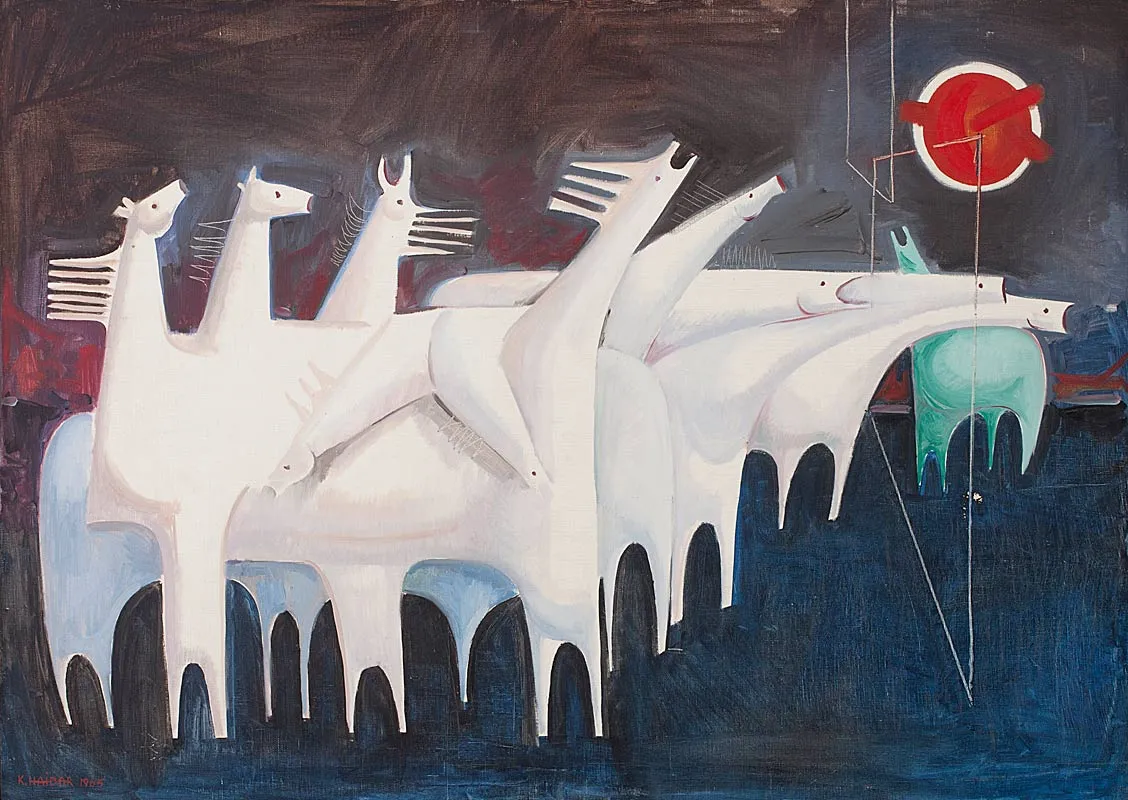
Kadhim Hayder, Fatigued Ten Horses Converse with Nothing (The Martyr’s Epic), 1965.
Madiha Tahir (Independent Journalist) began by asking: What does it mean to survive colonial violence? Focusing on the Pashtun anti-war movement in Pakistan, Tahir detailed the formation of a “spectral sovereign”, an arbiter of Pashtun life—born out of the myriad global imperial relationships fueling the boom of carceral topographies in Pakistan.
Randa Wahbe (Harvard University) continued by posing the question of what happens to life after insurrection. She detailed how the Israeli state withholds Palestinian bodies and also makes them illegible to their families. She describee these practices as cosmological warfare that served to suspend death and deny grief, altering the very temporality of death.
Amina Zarrugh (Texas Christian University) shifted the conversation to disappearance in the Libyan context, focusing on how this tool of state violence can open the door to unprecedented forms of resistance. She emphasized how analyses of economic grievances often obscure the routine instances of state violence, harassment, and degradation that create said grievances. Despite disappearance being one of the more powerful tools of state repression, Zarrugh stressed how conversely, the uncertainties and ambiguities of disappearance can compel people into resistance and even sustain movements.
Sinan Antoon (NYU) began his comments by asking: Where do we place beginnings and where do we place endings in regards to uprising and oppression? Concluding, he conveyed how each speaker highlighted the shifts and continuities of resistance, disrupting the ideological and methodological bounds of uprising itself.
If uprising is not a discrete event but a protracted temporality then how do we account for its various afterlives? For the ways it continues to exact an imprint or effect well after insurrectionary moments have passed? In particular, how do we factor things like the movement or displacement of people into our readings of uprising? Or, in turn, track the work of uprising in the political geographies of bordering, encampment, or sanctuary? Is there a way of reading migratory movement and its challenge to a waning border regime not just as the fallout but as the continuation of uprising? In other words not just as perceived but actual threats to established order. How, for example, can we read the Caravan of Hope or, its parallel moment in the Great March of Return, as not just the afterlife but the extension or re-formation of long-standing uprisings in Central America and Palestine respectively? What relation is there between what gets called “social movements” and the movement of people across borders? And in turn, how much of today’s counter-mobilization of the right is itself animated by real cracks in racializing mobility regimes?
Aslı Iğsız is an Associate Professor at New York University. Iğsız earned her B.A. from Boğaziçi University, Turkey (1993). She earned an M.A. in French Literature at Hacettepe University, Turkey (1996); an M.A. in Near Eastern Studies at the University of Michigan, Ann Arbor (2000); and a Ph.D. in Comparative Literature at the University of Michigan (2007).
Iğsız's research interests are multidisciplinary and mainly focus on the nineteenth and twentieth-century Ottoman and Turkish contexts and address a wide variety of issues. Her book Human Ruins: Dynamics of Multiculturalism and Greco-Turkish Memory Zones in Contemporary Turkey, undertakes a multidisciplinary approach and explores cultural memory and representation and politics of “multiculturalism” in post-1980 military coup era Turkey, with a special focus on Greco-Turkish shared heritage and the culture of “minority.”
Léopold Lambert is a trained architect living in Paris. He is the editor-in-chief of the print and online magazine The Funambulist, which attempts to articulate anti-colonial and anti-racist perspectives on the politics of space and bodies. He is also an independent researcher and the author of the books Weaponized Architecture: The Impossibility of Innocence (dpr-barcelona, 2012), Topie Impitoyable: The Corporeal Politics of the Cloth, the Wall, and the Street (punctum books, 2015), and Politics of Bulldozer: The Palestinian Ruin as an Israeli Project (B2, 2016, French). His next book is entitled States of Emergency: A Spatial History of the French Colonial Continuum (forthcoming 2021, Premiers Matins de Novembre, French).
A. Naomi Paik is the author of Bans, Walls, Raids, Sanctuary: Understanding U.S. Immigration for the 21st Century (2020, University of California Press), which examines the criminalization of immigrants in the U.S. and the need for a radical, abolitionist approach to sanctuary movements.
She also published her first book, Rightlessness: Testimony and Redress in U.S. Prison Camps since World War II in 2016 (UNC Press; winner, Best Book in History, AAAS 2018; runner-up, John Hope Franklin prize for best book in American Studies, ASA, 2017), as well as articles, opinion pieces, and interviews in a range of academic and public-facing venues. As a board member of the Radical History Review, she has co-edited three special issues of the journal—on “Militarism and Capitalism (Winter 2019), “Radical Histories of Sanctuary” (Fall 2019), and “Policing, Justice, and the Radical Imagination” (Spring 2020)—and will coedit “Against the Anthropocene” with Ashley Dawson (Winter 2023). Collaborating with Gerry Cadava and Cat Ramirez, she is also coediting the “Borderlands” section of Public Books. She is an associate professor at the University of Illinois, Urbana-Champaign, the HRI-Mellon faculty fellow in Legal Humanities, and the Center for Advanced Studies Resident Associate for the Initiative on “Abolition.” Her research and teaching interests include comparative ethnic studies; U.S. imperialism; U.S. militarism; social and cultural approaches to legal studies; transnational and women of color feminisms; carceral spaces; and labor, race, and migration.
Paula Chakravarty is an associate professor at the Gallatin School and the Department of Media, Culture and Communication. Her research and teaching interests span comparative political economy, migration, labor and social movements , and decolonial and critical race theory.
Her books include Race, Empire and the Crisis of the Subprime (Johns Hopkins University Press, 2013), Media Policy and Globalization (Edinburgh University Press, 2006), and Global Communications: Towards a Transcultural Political Economy (Rowman & Littlefield Publishers, 2008). She serves on the executive board of the NYU Association for University Professors (AAUP), and is affiliated faculty at the Asian/Pacific/American Institute at NYU, South Asia @ NYU, and the NYU Hagop Kevorkian Center for Near Eastern Studies.
In this virtual event, Aslı Iğsız (NYU) discussed mobility in the Turkish context in the aftermath of the uprisings in the Middle East. She emphasized the contradictions in Turkey’s response to the uprising and the linkages between uprising and mobility. For example, Turkey took in Syrian migrants and decried racism in the United States while simultaneously erecting a wall between Europe and the Middle East and suppressing dissent within Turkey.
Léopold Lambert (The Funambulist) shared work from his upcoming book discussing the connections between the Algerian Revolution, the Kanak Insurrection, and the Banlieue Uprising as a “colonial continuum.” He then highlighted the importance of thinking through these uprisings and the responses of the French state to them in terms of the “space-time” of colonial mobility.
Considering the US context, A. Naomi Paik (University of Illinois, Urbana-Champaign) discussed migration as a form of decolonization, wherein the refusal to abide by the restrictions of borders is an act of resistance to the neoliberal order. In this context, she showed how the sanctuary movement can be thought of not as a humanitarian movement, but as a way of thinking about the undoing of neoliberal capitalism and state subject-making.
Paula Chakravartty (NYU) asked the panelists to think through the internal contradictions of liberalism, the relationship between mobility and debt, the rise of ethno-nationalism, and how we can begin to reimagine the role of the state.